C major pentatonic in fourth position
Fretquest · Scale map · Band IV · building
C 大调五声 · 第 IV 把位
- Tuning
- Standard E A D G B E
- Fret window
- Frets 10–12
- Scale
- C major pentatonic
- Root
- C
- Tempo
- 76 BPM
- Difficulty
- 2 / 5 · building
Eleven dots and one root
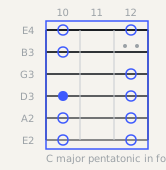
Inside frets 10 to 12 the C major pentatonic gives: string 6 fret 10 (D) and fret 12 (E); string 5 fret 10 (G) and fret 12 (A); string 4 fret 10 (C) and fret 12 (D); string 3 fret 12 (G); string 2 fret 10 (A); string 1 fret 10 (D) and fret 12 (E). The single root inside the window is string 4 fret 10, drawn solid.
Seven of the eleven dots sit on fret 10 or fret 12. Fret 11 is completely absent, which makes this window unusually easy to read: the shape is two parallel sets of dots with an empty fret between them, and the empty fret is a useful visual marker when you are moving fast.
- String 6: fret 10 = D (2), fret 12 = E (3)
- String 5: fret 10 = G (5), fret 12 = A (6)
- String 4: fret 10 = C (root), fret 12 = D (2)
- String 3: fret 12 = G (5)
- String 2: fret 10 = A (6)
- String 1: fret 10 = D (2), fret 12 = E (3)
The relative-minor shortcut
C major pentatonic and A minor pentatonic contain exactly the same five notes. The shapes are the same too — a C major pentatonic box two frets higher than an A minor pentatonic box is the identical pattern of dots, because moving the whole shape up three frets would give the relative minor. That is the fastest way to learn this shape: take the A minor box you already know at frets 1 to 3, move it to frets 10 to 12, and call the resulting notes C major pentatonic.
What changes is which note you treat as home. Solo over a C major backing and the shape resolves to C on string 4 fret 10; solo over an A minor backing with the same fingers and the shape resolves to A on string 2 fret 10. Same dots, different destination.
- A minor pentatonic at frets 1 to 3 maps to C major pentatonic at frets 10 to 12
- Both boxes hold the same five notes: C D E G A
- Root on string 4 fret 10 when the backing is in C major
- Root on string 2 fret 10 when the backing is in A minor
Four bars and a barre option
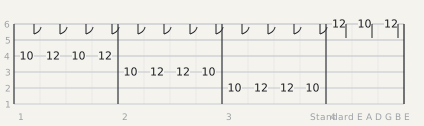
The tab climbs the fourth, third, second and first strings in eighth notes, two notes per string. Because every string uses only frets 10 and 12, there is an option the lower positions do not offer: lay the index finger flat across fret 10 and let it cover the whole fret, so the hand does not have to jump between strings.
The barre version is faster but harder to keep clean — a flat index finger tends to mute the string above it. Try both: the two-finger version first for accuracy, then the barre version once you can hear every note ring.
- Play bars 1 and 2 with separate fingers, listening for a clean ring on every note.
- Repeat them with the index finger barred flat across fret 10.
- Compare: if any note is muted in the barred version, go back to separate fingers.
- Finish with bars 3 and 4 and hold the last note for two beats.
Practice block · Bars 1–4 · 76 BPM
The staff scrolls sideways. Point at a bar, or tab to one and use the arrow keys, to cue it.
| Pattern | Left | Right | What to listen for |
|---|---|---|---|
| Two-note pairs | 1-3 | i m | Frets 10 and 12 on each string. Keep both fingers down between the two notes. |
| Barred version | 1 (barred) | i m i m | Index flat across fret 10. Listen for the string above the one you are playing. |
| Root landing | 1 | m | Land on string 4 fret 10 — the only root in the window — and hold it. |
Questions
Why is C major pentatonic the same as A minor pentatonic?
Because the two scales contain the same five notes: C D E G A. C major and A minor are relative keys, sharing all seven notes of the parent scale, and the pentatonic versions share five. The only difference is which note the player treats as the home note, and therefore where phrases resolve.
Should I barre fret 10 or use separate fingers?
For accuracy, separate fingers; for speed, the barre. A flat index finger at fret 10 covers all six strings, which means a note on any string can be played without moving the hand — but it also means any imprecision in the finger's curve will mute a note. Learn it both ways and choose per passage.
Terms used in this lesson
Box position方框把位(Box position)
A compact group of scale notes that sits under the hand in one place on the neck, playable without shifting. A box is defined by its lowest fret, not by its root, and the same box shape appears at several places on the neck because the guitar's tuning repeats the same intervals between string pairs.
Scale degree音阶级数(Scale degree)
The number a scale note occupies when the scale is counted from its root upward: 1 for the root, 2 for the next note, and so on. A prefix of b lowers the degree by a semitone and # raises it, so b3 means the third degree flattened — the note that makes a minor pentatonic sound minor.
Barre (bar chord)横按(Barre)
Pressing one finger flat across several strings at the same fret so that all of them sound. A barre is required whenever a shape has no open strings to rely on, and it fails in a characteristic way: the strings under the middle of the finger are muted because the finger's curve leaves them unpressed.
Fret marker品位标记(点)
The inlay dots on the fretboard, placed at frets 3, 5, 7, 9, 12, 15 and above. Markers are landmarks for the left hand when shifting and for the eye when reading: the double dot at fret 12 marks the octave, and knowing where it is keeps the hand from drifting a fret sharp or flat.
Plate files (SVG)
Fretboard matrix plate · Tab staff plate
/img/fret-c-major-pentatonic-fourth-position.svg · /img/tab-c-major-pentatonic-fourth-position.svg