String skipping: single-note arpeggio patterns across frets 10–12
Fretquest · Technique · Band IV · upper register
弦跳:10–12 品上的单音分解音型
- Tuning
- Standard E A D G B E
- Fret window
- Frets 10–12
- Scale
- A minor pentatonic
- Root
- A
- Tempo
- 60 BPM
- Difficulty
- 5 / 5 · upper register
What makes skipping harder than it looks
On a stepwise run the pick travels to the next string along a predictable, shallow path. When you skip a string, the pick has to clear the string in between entirely, and the natural instinct is to lift the whole hand instead of adjusting the pick's arc. Lifting the hand costs time and makes the skipped note late.
The fix is to keep the hand anchored and change the arc of the stroke: for a skip from string 1 to string 3, the downstroke travels a longer arc rather than a deeper one. Anchoring the heel of the hand on the bridge makes this much easier to control, because the hand is not free to lift.
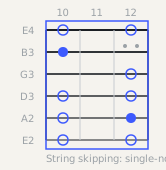
Out-of-sequence notes make this much easier to check. The notes of an A minor arpeggio inside frets 10 to 12 are given in the table below, and every one of them is a candidate for a skip.
- A on string 1 fret 10 and string 2 fret 10 — string 2 is the low root
- C on string 1 fret 12, string 2 fret 12, string 4 fret 10 and string 5 fret 10
- E on string 1 fret 12 and string 3 fret 12 and string 4 fret 12
Bars 1 and 2 — the basic skip
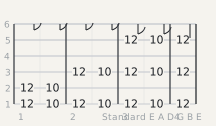
Bar 1 alternates string 1 and string 2 in pairs and moves immediately to a skip in bar 2, where the pattern becomes string 1, string 3, string 1, string 3. That single-string gap between the second and fourth notes of the bar is the whole difficulty of the study, and it repeats eight times in a bar of sixteenth notes.
Play bar 2 at 60 BPM and watch the pick: if the hand rises on the skip, the note after it will be late. The correct motion keeps the hand at a constant height and changes only the angle and length of the stroke.
Practice block · Bars 1–2 · 60 BPM
The staff scrolls sideways. Point at a bar, or tab to one and use the arrow keys, to cue it.
Bars 3 and 4 — widening the gap to two strings
Bar 3 moves to string 5, so the skip now spans strings 1 to 3 to 5, which is a two-string gap in both directions. At 60 BPM in eighth notes this is slow enough to hear every skip separately, and it is much better to practise slowly here than to rush into sixteenths and lose the timing.
Bar 4 removes the alternation entirely and plays three quarter notes on three different strings, each one a skip. That version isolates the string change from the note rate — if the quarters are uneven, the problem is the skip, not the speed.
- Play bar 3 with the fretting hand muted so you hear only the pick attack.
- Confirm each of the three strings produces the same volume.
- Release the mute and play the bar again at the same tempo.
- Finish with bar 4, one note per beat, listening for the skip to be silent.
Practice block · Bars 3–4 · 60 BPM
The staff scrolls sideways. Point at a bar, or tab to one and use the arrow keys, to cue it.
| Pattern | Left | Right | What to listen for |
|---|---|---|---|
| One-string skip | 1-3 | ↓ ↑ ↓ ↑ | Strings 1 and 3. Change the arc of the stroke, not the height of the hand. |
| Two-string skip | 1-3-1 | ↓ ↑ ↓ | Strings 1, 3 and 5. Anchor the heel of the picking hand on the bridge. |
| Skip isolation | 1 | ↓ ↓ ↓ | Bar 4: one note per beat, three different strings, no alternation to hide behind. |
Questions
Is string skipping a beginner technique?
No. It assumes that stepwise alternate picking is already even, because a skip exaggerates any existing imbalance in the picking hand — a skip played with an uneven stroke sounds twice as uneven as a run. It is normally introduced after a year or more of stepwise picking.
Do I need to mute the skipped string?
Yes, and it is the detail most players miss. When the pick crosses an unused string it can sound it by accident, producing a stray open note under the melody. Rest the edge of the picking hand lightly across the strings you are not playing, and the same hand also supplies the mute for the skips.
Terms used in this lesson
String skipping跳弦(String skipping)
Playing a line that leaps over one or more strings instead of moving to the neighbouring one. Skipping breaks the scale's visual box, forces the picking hand to control a wider arc, and is used to write melodies that would sound like plain scales if every note were on adjacent strings.
Alternate picking交替拨弦(上下交替)
Strictly alternating down and up strokes with the pick, one stroke per note. Alternate picking gives even rhythm and high attainable speed once the up stroke is as strong as the down, but it forces a change of stroke direction at every string crossing, which is where most players lose time.
Barre (bar chord)横按(Barre)
Pressing one finger flat across several strings at the same fret so that all of them sound. A barre is required whenever a shape has no open strings to rely on, and it fails in a characteristic way: the strings under the middle of the finger are muted because the finger's curve leaves them unpressed.
Broken chord分解和弦(Broken chord)
A chord whose notes are played one at a time rather than all together, usually low to high. Broken chords turn a static harmony into a moving texture and are the standard way to accompany a melody without the accompaniment competing with it for the listener's attention.
Plate files (SVG)
Fretboard matrix plate · Tab staff plate
/img/fret-string-skipping-arpeggio-study-fourth-position.svg · /img/tab-string-skipping-arpeggio-study-fourth-position.svg