B minor pentatonic in fourth position
Fretquest · Scale map · Band IV · intermediate
B 小调五声 · 第 IV 把位
- Tuning
- Standard E A D G B E
- Fret window
- Frets 10–12
- Scale
- B minor pentatonic
- Root
- B
- Tempo
- 70 BPM
- Difficulty
- 3 / 5 · intermediate
Ten dots, one root, and an odd note on fret 11
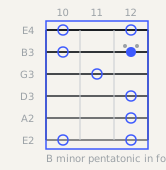
The window contains: string 6 fret 10 (D) and fret 12 (E); string 5 fret 12 (A); string 4 fret 12 (D); string 3 fret 11 (F sharp); string 2 fret 10 (A) and fret 12 (B); string 1 fret 10 (D) and fret 12 (E). Nine dots sit on frets 10 and 12, and exactly one — F sharp on the third string — sits on fret 11.
That lone fret-11 note is what makes this box harder than C major pentatonic in the same frets. It breaks the two-row symmetry: the hand has to reach one fret further with one finger while everything around it stays put, and a player who has memorised fret-10-or-12 patterns will consistently miss it.
- String 6: fret 10 = D (b3), fret 12 = E (4)
- String 5: fret 12 = A (b7)
- String 4: fret 12 = D (b3)
- String 3: fret 11 = F sharp (5)
- String 2: fret 10 = A (b7), fret 12 = B (root)
- String 1: fret 10 = D (b3), fret 12 = E (4)
Playing the F sharp deliberately
Spend the first few minutes on the third string alone: fret 11, then fret 12, then fret 11 again. The two frets are a semitone apart, and the string sits between two strings that want frets 10 and 12 — so the finger has to leave the shape and come back.
Once that reach is reliable, join it to the notes above and below. String 2 fret 12 is the root, so the phrase string 2 fret 9 to fret 11 to fret 12 is the sound of the scale arriving home, and it is worth playing twenty times slowly before running the whole box.
- Play string 3 fret 11 as quarter notes at 70 BPM, listening for the fifth degree against the root.
- Add string 2 fret 12 and alternate the two.
- Play the whole window ascending slowly, stopping on the F sharp.
- Descend and finish on string 2 fret 12, holding it.
Four bars around the box
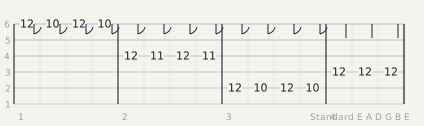
The tab climbs from the first string down to the fifth and closes with a three-note figure on the fourth string, all in eighth notes. Bar 2 is the awkward one: it pairs frets 12 and 11 on the fourth string, which is the semitone reach again in a different place, and it will feel different from the same interval on the third string because the finger arrives from the other direction.
B minor pentatonic is a useful box because it sits exactly where the C major pentatonic box sits, two frets lower. Play the same shapes at frets 8 to 10 and you are in A minor pentatonic; at frets 10 to 12 with the root on string 2 you are in B minor. The dots do not move much — the home note does.
Practice block · Bars 1–4 · 70 BPM
The staff scrolls sideways. Point at a bar, or tab to one and use the arrow keys, to cue it.
| Pattern | Left | Right | What to listen for |
|---|---|---|---|
| The lone fret-11 note | 2 on string 3 | i | Reach for it, then bring the finger back to the shape; do not leave it hovering on fret 11. |
| Root arrival | 2-1-2 on string 2 | m i m | Frets 9, 11, 12 on string 2 — the phrase resolving to the root. |
| Semitone pair | 3-2 on string 4 | m i | Bar 2 pairs frets 12 and 11. Half-step pulls like this need a small, controlled finger movement. |
Questions
Why does this box have only one note on the third string?
Because of where the scale's five notes fall on that string's open pitch. The third string's open note is G, and in B minor pentatonic the notes reachable in frets 10 to 12 on that string are only F sharp at fret 11 — B and D would require frets 16 and 19, outside the window.
Is B minor pentatonic the same as D major pentatonic?
Yes — B minor pentatonic and D major pentatonic contain the same five notes: B D E F sharp A. As with all relative pairs, the difference is which note functions as home. Solo over B minor material and the phrases should resolve to B; over D major material the same notes resolve to D.
Terms used in this lesson
Box position方框把位(Box position)
A compact group of scale notes that sits under the hand in one place on the neck, playable without shifting. A box is defined by its lowest fret, not by its root, and the same box shape appears at several places on the neck because the guitar's tuning repeats the same intervals between string pairs.
Root note根音(第一级音)
The note a scale or chord is named after and the note the music resolves to. In a scale diagram the root is marked differently from every other degree because it is the pitch the ear hears as home, and phrases that end on it sound finished while phrases that end elsewhere sound suspended.
Scale degree音阶级数(Scale degree)
The number a scale note occupies when the scale is counted from its root upward: 1 for the root, 2 for the next note, and so on. A prefix of b lowers the degree by a semitone and # raises it, so b3 means the third degree flattened — the note that makes a minor pentatonic sound minor.
Broken chord分解和弦(Broken chord)
A chord whose notes are played one at a time rather than all together, usually low to high. Broken chords turn a static harmony into a moving texture and are the standard way to accompany a melody without the accompaniment competing with it for the listener's attention.
Plate files (SVG)
Fretboard matrix plate · Tab staff plate
/img/fret-b-minor-pentatonic-fourth-position.svg · /img/tab-b-minor-pentatonic-fourth-position.svg