An open G bass line under a G major melody
Fretquest · Tab piece · Band IV · upper register
G 大调旋律之下的 Open G 低音线
- Tuning
- Open G D G D G B D
- Fret window
- Frets 10–12
- Scale
- G major pentatonic
- Root
- G
- Tempo
- 68 BPM
- Difficulty
- 5 / 5 · upper register
Where the notes are in this window
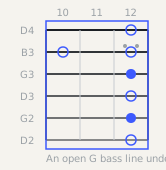
Inside frets 10 to 12 in open G: string 6 fret 12 gives D; string 5 fret 12 gives G, the root; string 4 fret 12 gives D; string 3 fret 12 gives G, the root an octave up; string 2 fret 10 gives A and string 1 fret 10 gives D, with string 1 fret 12 giving E.
There are two roots in the window, on strings 5 and 3, and they are an octave apart. That pairing is the reason this study works: the bass line can be played on string 5 while the melody answers on string 3, and both are the same note — so the ear hears one pitch distributed across the range rather than two competing ones.
- String 6 fret 12 = D (5)
- String 5 fret 12 = G (root)
- String 4 fret 12 = D (5)
- String 3 fret 12 = G (root, octave up)
- String 2 fret 10 = A (2)
- String 1 fret 10 = D (5); fret 12 = E (6)
Building two voices out of one hand
The tab keeps the bass on the fifth and fourth strings and the melody on the first and second, and it never plays both at once — the two voices alternate. That is a deliberate simplification: playing a bass note and a melody note simultaneously in open G requires the picking hand to cover strings that are four apart, and at this tempo that is a separate skill.
Play the bass notes with the thumb side of the pick and the melody notes with the tip, if you play with a pick, or use thumb and index if you play fingerstyle. The difference in tone between the two voices is what makes them sound like two parts rather than one arpeggio.
- Play only the fifth and fourth strings for two bars; this is the bass line alone.
- Play only the first and second strings; this is the melody alone.
- Join them, keeping the bass slightly louder and the melody slightly softer.
- Listen for the two roots on strings 5 and 3 and let them ring together once at the end.
Four bars in open G
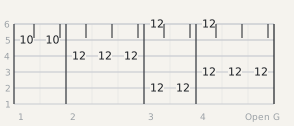
Bar 1 opens with the second string at fret 10 and the fourth string at fret 12 — an A and a D, the two notes that sit above the G root and make an open-G chord sound suspended rather than settled. Bar 2 answers on the third string with three root notes in a row, which is the plainest possible statement of the tonality.
Bars 3 and 4 combine the fifth string root with the first string at fret 12, then close on a chord-shaped figure across strings 4, 3 and 1. Everything here is at frets 10 to 12, and the reason the study is graded difficult is not the frets but the voice separation: two things have to be heard from one hand, and that only happens when the picking is deliberate.
Practice block · Bars 1–4 · 68 BPM
The staff scrolls sideways. Point at a bar, or tab to one and use the arrow keys, to cue it.
| Pattern | Left | Right | What to listen for |
|---|---|---|---|
| Bass on string 5 | 3 | p / pick edge | Fret 12 is the root. Let it ring while the melody note is prepared. |
| Melody on string 1 | 1-2 | i / pick tip | Frets 10 and 12. Keep it slightly softer than the bass. |
| Two roots together | 2-3 | m a | Strings 5 and 3 at fret 12 — same note, one octave apart. Play them together at the end. |
Questions
Can I play this with a pick or do I need fingers?
Both work. With a pick, use the thumb edge for the low strings and the tip for the melody, which produces two distinct tones. Fingerstyle is easier for the separation — thumb on the bass, index on the melody — and harder to keep even in volume. Choose based on which weakness you want to work on.
Why does open G sound so different from standard tuning up here?
Because the intervals between adjacent strings are different. In standard tuning four of the five string pairs are a fourth apart; in open G they alternate between a fourth and a fifth, and the third string sits a major third above the second-string group rather than a fourth. The same fret numbers therefore produce different intervals at every string crossing.
Terms used in this lesson
Open string空弦(不按品)
A string played without pressing any fret, written as 0 in tab. Open strings ring longer and sound brighter than fretted notes because the whole string length vibrates, and they cannot be bent by the left hand — which is why phrases that need expression avoid landing on them.
Tablature六线谱(TAB)
Notation that shows music as six lines, one per string, with numbers indicating which fret to press. Tab says nothing directly about pitch or duration — both have to be inferred from the tuning and the rhythm stems — but it removes the need to translate a written note into a fret before playing it.
Broken chord分解和弦(Broken chord)
A chord whose notes are played one at a time rather than all together, usually low to high. Broken chords turn a static harmony into a moving texture and are the standard way to accompany a melody without the accompaniment competing with it for the listener's attention.
Plectrum拨片(Pick)
The pick, held between thumb and index finger with only a small tip protruding. How much tip is exposed controls the tone as much as the pick's thickness: a small tip produce a tighter, more controlled attack and less pick noise against the strings, while a large tip produces a louder, sloppier one.
Plate files (SVG)
Fretboard matrix plate · Tab staff plate
/img/fret-open-g-bass-line-under-a-g-major-melody.svg · /img/tab-open-g-bass-line-under-a-g-major-melody.svg