Open G study: the low strings fourteen frets up
Fretquest · Tab piece · Band V · intermediate
Open G 研究:把低音弦弹到第十四品
- Tuning
- Open G D G D G B D
- Fret window
- Frets 13–15
- Scale
- G major pentatonic
- Root
- G
- Tempo
- 72 BPM
- Difficulty
- 3 / 5 · intermediate
Why the same shape works three times
The sixth, fourth and first strings of an open-G guitar are all D — an octave and a fifth apart, but the same note name. That means a phrase played on string 6 at fret 14 can be repeated note-for-note on string 4 fret 14, and again on string 1 fret 14, and all three will be the same melody at different octaves.
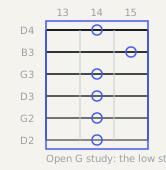
In the window below, string 5 fret 14, string 4 fret 14, string 3 fret 14 and string 1 fret 14 all give the note A; string 5 fret 15, string 4 fret 15 and string 6 fret 14 give B flat, C and E respectively. The three identical A notes are worth finding first, because they make the tuning's logic audible in one movement.
- String 6 fret 14 = E; string 6 fret 13 = D sharp, out of the key
- String 5 fret 14 = A; string 5 fret 15 = B flat, out of the key
- String 4 fret 14 = E; string 4 fret 15 = F, out of the key
- String 3 fret 14 = A; string 3 fret 15 = B flat, out of the key
- String 2 fret 15 = D; string 2 fret 14 = C sharp, out of the key
- String 1 fret 14 = E; string 1 fret 15 = F, out of the key
Playing the same note on three strings
Play string 5 fret 14, then string 4 fret 14, then string 1 fret 14, slowly. All three are A, an octave apart. A beginner listening from across the room should hear one repeated note, not three different ones — if the third sounds different in pitch rather than just in tone, the tuning has drifted.
This is also a practical tuning check for open G. Tuning a guitar by ear to an open chord is convenient but drift-prone: matching fret 14 across strings 5, 4 and 1 catches errors that a chord strum will hide, because a chord can sound acceptable with one string a few cents out.
- Play fret 14 on strings 5, 4 and 1, one note per beat.
- Listen for three identical pitches at different octaves.
- If any is out, adjust the string at the machine head and repeat.
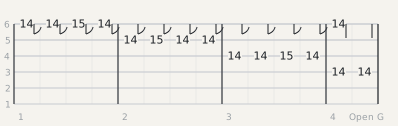
- Then play frets 14 and 15 on string 3 as eighth notes at 72 BPM.
Four bars and the register question
The study stays on frets 14 and 15 across the first, second, third and fifth strings and closes with a two-note figure on the third string and a single held note on the first. Every bar uses one string, so the picking hand never has to skip and the left hand never has to shift.
Playing this high in open G produces a thin, bell-like sound because the strings are short and the tuning is open — two open-sounding notes are never more than a fret apart. That brightness is why slide players often work up here: the notes ring almost on their own, and any unwanted contact with a neighbouring string is immediately audible.
Practice block · Bars 1–4 · 72 BPM
The staff scrolls sideways. Point at a bar, or tab to one and use the arrow keys, to cue it.
| Pattern | Left | Right | What to listen for |
|---|---|---|---|
| Three identical As | 2 | i m i | Strings 5, 4 and 1 at fret 14. Same pitch, three octaves apart. |
| High-register pairs | 1-2 | ↓ ↑ | Frets 14 and 15 alternate. Up here a semitone is a small movement. |
| Tuning check | 2 | m | Play fret 14 on strings 5, 4 and 1 and listen for a single repeated note. |
Questions
Which strings should I tune to the open chord by ear?
Tune the fifth string to G as your reference, then match strings 6 and 4 to it an octave apart, and finally strings 3, 2 and 1 against the fourth string's twelfth fret. Checking fret 14 across strings 5, 4 and 1 afterwards catches any drift in the middle of the neck.
Is open G the same as open A?
No, but they are related: open A is open G tuned up a whole tone, which puts the sixth string at E and often breaks it. Most players who want open A use open G with a capo at the second fret instead, which preserves the string tension and the shape.
Terms used in this lesson
Open string空弦(不按品)
A string played without pressing any fret, written as 0 in tab. Open strings ring longer and sound brighter than fretted notes because the whole string length vibrates, and they cannot be bent by the left hand — which is why phrases that need expression avoid landing on them.
Fret marker品位标记(点)
The inlay dots on the fretboard, placed at frets 3, 5, 7, 9, 12, 15 and above. Markers are landmarks for the left hand when shifting and for the eye when reading: the double dot at fret 12 marks the octave, and knowing where it is keeps the hand from drifting a fret sharp or flat.
Alternate picking交替拨弦(上下交替)
Strictly alternating down and up strokes with the pick, one stroke per note. Alternate picking gives even rhythm and high attainable speed once the up stroke is as strong as the down, but it forces a change of stroke direction at every string crossing, which is where most players lose time.
Tablature六线谱(TAB)
Notation that shows music as six lines, one per string, with numbers indicating which fret to press. Tab says nothing directly about pitch or duration — both have to be inferred from the tuning and the rhythm stems — but it removes the need to translate a written note into a fret before playing it.
Plate files (SVG)
Fretboard matrix plate · Tab staff plate
/img/fret-open-g-tuning-low-string-study.svg · /img/tab-open-g-tuning-low-string-study.svg