Pull-off triplets above the twelfth fret
Fretquest · Technique · Band V · intermediate
第 12 品以上的勾弦三连音
- Tuning
- Standard E A D G B E
- Fret window
- Frets 13–15
- Scale
- A minor pentatonic
- Root
- A
- Tempo
- 56 BPM
- Difficulty
- 3 / 5 · intermediate
Three notes, one pick stroke
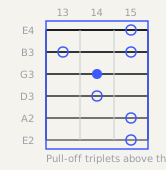
A triplet pull-off figure works like this: the ring finger presses fret 14 and is picked, then pulls off to the index finger at fret 12, which sounds the second note, and then the index pulls off again — or the ring finger hammers back — for the third. All three notes come from one right-hand stroke, so their relative volumes are entirely a left-hand matter.
Playing triplets evenly is harder than playing eighths evenly because there is no natural reinforcement from the metronome: the click lands on the first note of each triplet and then two notes fall in the gap. Counting one-two-three, one-two-three out loud is the only reliable way to keep them even at first.
- Pick the first note only
- Second note: pull off from fret 14 to fret 12, dragging the fingertip toward the palm
- Third note: hammer back up to fret 14, or pull the index finger off for the open string if one is available
- Count one-two-three against the click; the click always falls on one
Bars 1 and 2 — pull-off pairs at fret 12 and 14
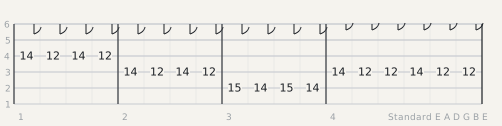
Bar 1 alternates frets 14 and 12 on the third string in eighth notes, which is two notes per beat; bar 2 does the same on the second string. These are the warm-up bars: two notes is easy enough to hear whether the pull-off is loud enough, and the answer should be yes on every single one.
Above the twelfth fret the distance between frets is short, so a finger that travels too far on the pull-off will land on the wrong side of the next wire. Keep the travel small — the fingertip only needs to move a couple of millimetres sideways to sound the string.
Practice block · Bars 1–2 · 56 BPM
The staff scrolls sideways. Point at a bar, or tab to one and use the arrow keys, to cue it.
Bars 3 and 4 — triplets and the closing figure
Bar 3 moves to the fifth string and plays frets 15 and 14 as eighth notes, which is a semitone pull-off and considerably harder: the finger has less distance to work with and the note is easier to smother. Bar 4 closes the study with a run of sixteenth-note pull-offs on the third string, six notes to the bar, all produced from two finger positions.
Keep the tempo at 56 BPM throughout. This is a slow exercise by design: the technique is being learned, not performed, and pull-off triplets that sound even at 56 BPM will still sound even at 100, whereas ones rushed to 100 will stay uneven at every tempo.
- Play bar 3 with the metronome at 56 BPM, counting one-two per beat.
- Move to bar 4 and count one-two-three-four per beat in sixteenths.
- Stop at any note that is lighter than its neighbours and repeat the bar.
- Record two minutes of the four bars and listen for the quiet notes.
Practice block · Bars 3–4 · 56 BPM
The staff scrolls sideways. Point at a bar, or tab to one and use the arrow keys, to cue it.
| Pattern | Left | Right | What to listen for |
|---|---|---|---|
| Pull-off pair | 3 → 1 | m (once) | Only the fret-14 note is picked; fret 12 comes from the drag of the ring finger. |
| Semitone pull | 4 → 3 | i (once) | String 5, frets 15 to 14. Half the distance, so halve the finger travel. |
| Triplet counting | 3-1-3 | m (once) | Count one-two-three out loud; the click falls on one every time. |
Questions
Why do pull-offs get quieter as I move up the neck?
Because the string has less length to vibrate, so it produces less energy for the same finger movement. The fix is a slightly faster, more decisive pull above the twelfth fret and less reliance on the string's natural sustain. Above fret 15 the pull-off has to be almost a pluck.
Should triplets be counted as one-two-three or as one-and-a?
Either works, but one-two-three with equal stress is more reliable for pull-off triplets because the third note is produced by a weaker motion and needs to be consciously placed. Counting one-and-a tends to make the third note a throwaway, which is exactly the fault being corrected.
Terms used in this lesson
Pull-off勾弦(Pull-off)
Sounding a note by pulling a finger off a fret with a sideways drag, so that the fingertip plucks the string as it leaves. A pull-off that only lifts the finger makes no sound at all; the movement has to be a small, decisive pull toward the palm, not a lift away from the fretboard.
Legato连奏(Legato)
Playing with hammer-ons, pull-offs and slides instead of separate pick strokes, so that notes are joined rather than articulated individually. Legato produces a smooth, singing line and demands more of the left hand, because every note's volume and clarity now depends on finger pressure rather than the pick.
Anchor finger锚指(固定手指)
A finger that stays pressed on one note while the others move around it. Anchoring reduces the amount of movement the hand has to make, keeps the hand oriented when the shape is unfamiliar, and gives the ear a fixed pitch to measure every other note against.
Metronome节拍器(Metronome)
A steady click at a fixed tempo, measured in beats per minute. The metronome does not make playing faster; it reveals where the playing stops matching the beat, which is the information you need before speed can be added at all. Practising without one usually means practising the same errors.
Plate files (SVG)
Fretboard matrix plate · Tab staff plate
/img/fret-pull-off-triplets-fifth-position.svg · /img/tab-pull-off-triplets-fifth-position.svg