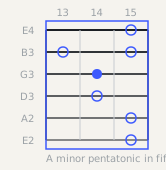
A minor pentatonic in fifth position, above the double marker
Fretquest · Scale map · Band V · intermediate
A 小调五声 · 第 V 把位(双点品记之上)
- Tuning
- Standard E A D G B E
- Fret window
- Frets 13–15
- Scale
- A minor pentatonic
- Root
- A
- Tempo
- 74 BPM
- Difficulty
- 3 / 5 · intermediate
The dots above the octave marker
Frets 13 to 15 hold these A minor pentatonic notes: string 6 fret 15 (C), string 5 fret 12 (A) and fret 15 (D), string 4 fret 12 (G) and fret 14 (A), string 3 fret 12 (G) and fret 14 (A), string 2 fret 13 (C) and fret 15 (D), string 1 fret 15 (G). The roots — string 5 fret 12 and string 4 fret 14 — are drawn solid.
Notice that fret 13 appears only once, on the second string. The window is not a neat three-fret box; it is a three-fret box whose top note on the second string is a semitone lower than the pattern would suggest, which is exactly the kind of exception that makes learning shapes by memory unreliable.
- String 6: fret 15 = C (flat 3)
- String 5: fret 12 = A (root), fret 15 = D (4)
- String 4: fret 12 = G (flat 7), fret 14 = A (root)
- String 3: fret 12 = G (flat 7), fret 14 = A (root)
- String 2: fret 13 = C (flat 3), fret 15 = D (4)
- String 1: fret 15 = G (flat 7)
Why the fingers have to close up
Fret spacing narrows as you move up the neck, and by the fifteenth fret the distance between two frets is roughly two thirds of what it is at the first. A hand that keeps its first-position spread will play sharp or buzz on the upper frets, because the fingertips land behind the wires instead of on them.
The practical fix is not to squeeze harder but to bring the thumb slightly higher on the back of the neck and let the fingers stay more curved. If your hand aches after two minutes at fret 15, the thumb is too low and the fingers are flattening to compensate.
- Frets 13 to 15 span roughly two thirds of the distance of frets 1 to 3
- Keep the fingertips curved; a flattened finger lands behind the wire
- Raise the thumb on the back of the neck instead of squeezing with the fingers
- If the hand aches after two minutes up here, the thumb is too low
Four bars that keep the hand in one place
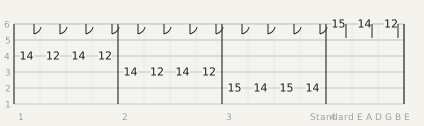
The drill pairs fret 12 with fret 14 on the fourth and third strings, then moves to fret 15 on the fifth string, and closes with a three-note descent on the top string. Nothing in it requires a shift, so the only variable is finger spacing.
Play it at 74 BPM. If notes on the top string sound thin or buzz, check the string height and the curvature of the finger rather than assuming the guitar is at fault: at fret 15 an over-flattened finger touches the adjacent string and kills the note.
- Play bar 1 with the hand as square as it would be at fret 1.
- Watch the fingers: no flattening to reach fret 14.
- Add bars 2 and 3 without letting the thumb creep upward off the neck.
- Finish on bar 4 and hold the last note for two beats to check for buzz.
Practice block · Bars 1–4 · 74 BPM
The staff scrolls sideways. Point at a bar, or tab to one and use the arrow keys, to cue it.
| Pattern | Left | Right | What to listen for |
|---|---|---|---|
| Fret 12 against 14 | 1-3 | i m | Keep the fingers curved; the fret spacing up here is two thirds of what it is at fret 1. |
| Reach to 15 | 4 | m | Pinky only. Do not flatten the hand to reach — raise the thumb instead. |
| Top-string descent | 4-3-1 | m i m | Three notes, two beats each at 74 BPM. Listen for buzz on the last one. |
Questions
Do scales above the twelfth fret sound different?
They sound the same pitches in a higher octave but with a slightly different tone colour, because the string is shorter and stiffer relative to its length. That is why lead players often repeat a phrase an octave higher above fret 12 rather than transposing it to a new key — the shape stays familiar and the tone lifts.
Should I practise scales this high up at all as a beginner?
Yes, but for a specific reason: it teaches the hand to keep a light, curved shape instead of relying on a stretched, flat fingering that only works in the lower positions. Ten minutes a week above the twelfth fret is enough to keep the habit alive.
Terms used in this lesson
Box position方框把位(Box position)
A compact group of scale notes that sits under the hand in one place on the neck, playable without shifting. A box is defined by its lowest fret, not by its root, and the same box shape appears at several places on the neck because the guitar's tuning repeats the same intervals between string pairs.
Scale degree音阶级数(Scale degree)
The number a scale note occupies when the scale is counted from its root upward: 1 for the root, 2 for the next note, and so on. A prefix of b lowers the degree by a semitone and # raises it, so b3 means the third degree flattened — the note that makes a minor pentatonic sound minor.
Root note根音(第一级音)
The note a scale or chord is named after and the note the music resolves to. In a scale diagram the root is marked differently from every other degree because it is the pitch the ear hears as home, and phrases that end on it sound finished while phrases that end elsewhere sound suspended.
Fret marker品位标记(点)
The inlay dots on the fretboard, placed at frets 3, 5, 7, 9, 12, 15 and above. Markers are landmarks for the left hand when shifting and for the eye when reading: the double dot at fret 12 marks the octave, and knowing where it is keeps the hand from drifting a fret sharp or flat.
Plate files (SVG)
Fretboard matrix plate · Tab staff plate
/img/fret-a-minor-pentatonic-fifth-position.svg · /img/tab-a-minor-pentatonic-fifth-position.svg
More in this band
—