A blues scale in third position: where the flat fifth lives
Fretquest · Scale map · Band III · building
A 布鲁斯音阶 · 第 III 把位:降五度住在哪里
- Tuning
- Standard E A D G B E
- Fret window
- Frets 7–9
- Scale
- A blues (minor pentatonic + b5)
- Root
- A
- Tempo
- 68 BPM
- Difficulty
- 2 / 5 · building
One extra dot: E flat on the third string
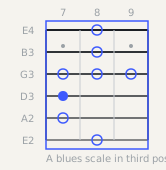
A blues scale contains A, C, D, E flat, E and G. Compared with A minor pentatonic, the only addition is E flat — the flat fifth. Inside frets 7 to 9 the playable dots are: string 6 fret 8 (C), string 5 fret 7 (E), string 4 fret 7 (A), string 3 fret 7 (D), fret 8 (E flat) and fret 9 (E), string 2 fret 8 (G), string 1 fret 8 (C).
Note that the flat fifth appears exactly once in the whole window, on string 3 fret 8, sandwiched between D at fret 7 and E at fret 9. That is a useful thing to know: the note is always a semitone away from a consonant note in the same window, which is exactly why it works as a passing tone.
- String 6 fret 8 — C, flat third
- String 5 fret 7 — E, fifth
- String 4 fret 7 — A, root
- String 3 fret 7 — D, fourth; fret 8 — E flat, flat fifth; fret 9 — E, fifth
- String 2 fret 8 — G, flat seventh
- String 1 fret 8 — C, flat third
Using the flat fifth as a passing note
The flat fifth is dissonant against almost everything, which means it is nearly always played on the way to somewhere else rather than held. Two standard uses: slide into it from the fourth below and then resolve up a semitone to the fifth, or bend into it from the fourth and release back down. Both make the note sound intentional rather than wrong.
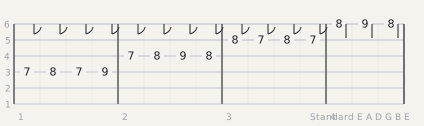
In fret numbers on the third string that is 7 to 8 to 9 — D, E flat, E — played as a quick three-note figure. Played slowly and held, the same three notes sound like a mistake. Tempo and context are what make the flat fifth work.
- Play 7-8-9 on the third string as three even eighth notes at 68 BPM.
- Now hold the 8 for a full beat and listen to the tension it creates.
- Return to the fast version and notice how the note stops sounding wrong.
- Repeat the figure on the second string using frets 7, 8 and 9 — different degrees, same shape.
Four bars that end on the root
The tab moves through frets 7, 8 and 9 on the third string, then takes the same figure to the fourth string, then to the second string, and finishes with a three-note descent on the first string ending on A. The last note is the root, held as a quarter, which is the standard way to close a blues phrase — the tension of the flat fifth earlier in the phrase needs somewhere consonant to land.
At 68 BPM the whole thing takes about seven seconds. Play it four times, then improvise one bar of your own replacing the written notes with any frets from the table above.
Practice block · Bars 1–4 · 68 BPM
The staff scrolls sideways. Point at a bar, or tab to one and use the arrow keys, to cue it.
| Pattern | Left | Right | What to listen for |
|---|---|---|---|
| Flat-fifth walk | 1-2-4 | i m i | String 3, frets 7-8-9. Three even eighths; do not linger on the middle note. |
| Hold test | 2 (held) | m | Hold fret 8 for a full beat to hear how unstable it is. That instability is the point. |
| Resolution to the root | 1-4-1 | m i m | Close on A (string 1 fret 8) and let it ring as a quarter note. |
Questions
Why does the blues scale have a note that sounds wrong?
Because the flat fifth is a passing tone, not a chord tone — it is deliberately unstable and is meant to be heard on the way to the fifth or the fourth. Western harmony has used unstable passing notes for centuries; the blues scale simply makes one of them a permanent member of the scale.
Should I bend to the flat fifth or play it fretted?
Both are used, but for a beginner fretting it is more reliable because a bend has to land exactly on pitch to sound intentional. Learn the fretted version first, and add a bend from fret 7 to fret 8 on the third string once you can hear the target pitch clearly before you play it.
Terms used in this lesson
Scale degree音阶级数(Scale degree)
The number a scale note occupies when the scale is counted from its root upward: 1 for the root, 2 for the next note, and so on. A prefix of b lowers the degree by a semitone and # raises it, so b3 means the third degree flattened — the note that makes a minor pentatonic sound minor.
Box position方框把位(Box position)
A compact group of scale notes that sits under the hand in one place on the neck, playable without shifting. A box is defined by its lowest fret, not by its root, and the same box shape appears at several places on the neck because the guitar's tuning repeats the same intervals between string pairs.
Root note根音(第一级音)
The note a scale or chord is named after and the note the music resolves to. In a scale diagram the root is marked differently from every other degree because it is the pitch the ear hears as home, and phrases that end on it sound finished while phrases that end elsewhere sound suspended.
Fret marker品位标记(点)
The inlay dots on the fretboard, placed at frets 3, 5, 7, 9, 12, 15 and above. Markers are landmarks for the left hand when shifting and for the eye when reading: the double dot at fret 12 marks the octave, and knowing where it is keeps the hand from drifting a fret sharp or flat.
Plate files (SVG)
Fretboard matrix plate · Tab staff plate
/img/fret-a-blues-scale-third-position.svg · /img/tab-a-blues-scale-third-position.svg