G major pentatonic in third position
Fretquest · Scale map · Band III · building
G 大调五声 · 第 III 把位
- Tuning
- Standard E A D G B E
- Fret window
- Frets 7–9
- Scale
- G major pentatonic
- Root
- G
- Tempo
- 70 BPM
- Difficulty
- 2 / 5 · building
Twelve dots, two of them roots
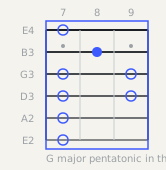
Inside frets 7–9 the G major pentatonic gives twelve dots: string 6 fret 7 (B), string 5 fret 7 (E), string 4 fret 7 (A) and fret 9 (B), string 3 fret 7 (D) and fret 9 (E), string 2 fret 8 (G), string 1 fret 7 (B). Only string 2 fret 8 is a G — the single root inside the window, drawn as a solid dot on the plate above.
That missing root is the main thing to notice about a pentatonic box that is not rooted on the low strings: you are playing degrees 2, 3, 5 and 6 for most of the window, and the root appears once. Phrases built here tend to resolve downward to that string 2 fret 8 rather than ending on the low strings.
- String 6 fret 7 — B, degree 3
- String 5 fret 7 — E, degree 6
- String 4 fret 7 — A, degree 2; fret 9 — B, degree 3
- String 3 fret 7 — D, degree 5; fret 9 — E, degree 6
- String 2 fret 8 — G, root (the only one in the window)
- String 1 fret 7 — B, degree 3
Reading the fret markers instead of counting
Most guitars carry a single marker at fret 7 and a double marker at fret 12, with single markers at 3, 5, 9 and 15. In third position the index finger sits just behind the 7th-fret marker, which gives you two free reference points: the marker under the index and the gap where fret 8 has no marker at all. Using the markers to orient yourself takes a fraction of a second; counting from the nut does not.
The rule is that the marker sits between the frets it labels — a marker at 7 marks the space between the 6th and 7th fret wires on most necks, so the finger lands on the wire side of the dot, not centred on it.
- Fret 3 — single dot
- Fret 5 — single dot
- Fret 7 — single dot, sitting under the index finger in third position
- Fret 9 — single dot
- Fret 12 — double dot, the octave of the open string
- Fret 15 — single dot, the far end of the map
Four-bar loop through the window
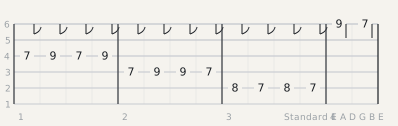
The tab alternates two notes from a single string per bar: string 3 pairs 7 and 9, string 4 pairs 7 and 9, string 2 pairs 8 and 7, and the last bar plays a two-note figure on the top string. Every pair spans a whole tone except the string 2 pair, which spans a semitone-to-whole-tone shape and is the awkward one.
Play it at 70 BPM in eighth notes. The point of pairing notes on one string is to hear the interval rather than the finger movement: frets 7 to 9 on the fourth string is a whole tone, A to B, and it should sound identical in size to frets 7 to 9 on the third string, D to E.
Practice block · Bars 1–4 · 70 BPM
The staff scrolls sideways. Point at a bar, or tab to one and use the arrow keys, to cue it.
| Pattern | Left | Right | What to listen for |
|---|---|---|---|
| Whole-tone pairs | 2-4 | i m | Frets 7 and 9 on one string. Keep both fingers down until the second note sounds. |
| Semitone step up | 3-2 | m i | String 2, frets 8 back to 7. The smallest move in the shape — slow it down. |
| Marker check | 2 | p | Land the index behind the 7th-fret marker without looking at the nut. |
Questions
Why does the index finger start on fret 7 rather than 8?
Because third position is defined by the index finger taking fret 7, which leaves frets 8 and 9 for the middle and ring fingers and puts the whole window under a 2-3-4 fingering. Starting on fret 8 would leave fret 7 unreachable without a shift, and the shape would fall apart on the low strings.
Is there a G major pentatonic shape with the root on the low E string?
Yes — that shape lives around fret 3, where string 6 fret 3 is G. The two shapes cover the same five notes in different octaves; players usually learn the low-root shape first and then add this one as the upper octave of the same idea.
Terms used in this lesson
Box position方框把位(Box position)
A compact group of scale notes that sits under the hand in one place on the neck, playable without shifting. A box is defined by its lowest fret, not by its root, and the same box shape appears at several places on the neck because the guitar's tuning repeats the same intervals between string pairs.
Scale degree音阶级数(Scale degree)
The number a scale note occupies when the scale is counted from its root upward: 1 for the root, 2 for the next note, and so on. A prefix of b lowers the degree by a semitone and # raises it, so b3 means the third degree flattened — the note that makes a minor pentatonic sound minor.
Fret marker品位标记(点)
The inlay dots on the fretboard, placed at frets 3, 5, 7, 9, 12, 15 and above. Markers are landmarks for the left hand when shifting and for the eye when reading: the double dot at fret 12 marks the octave, and knowing where it is keeps the hand from drifting a fret sharp or flat.
Anchor finger锚指(固定手指)
A finger that stays pressed on one note while the others move around it. Anchoring reduces the amount of movement the hand has to make, keeps the hand oriented when the shape is unfamiliar, and gives the ear a fixed pitch to measure every other note against.
Plate files (SVG)
Fretboard matrix plate · Tab staff plate
/img/fret-g-major-pentatonic-third-position.svg · /img/tab-g-major-pentatonic-third-position.svg