Open G slide phrases between frets 7 and 9
Fretquest · Tab piece · Band III · building
Open G 调弦下 7 至 9 品的滑音短句
- Tuning
- Open G D G D G B D
- Fret window
- Frets 7–9
- Scale
- G major pentatonic
- Root
- G
- Tempo
- 76 BPM
- Difficulty
- 2 / 5 · building
What the open strings give you for free
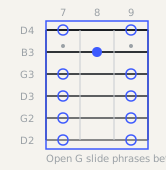
Six open strings in open G sound D, G, D, G, B and D. Four of them are G or D, which are the root and fifth of the key; the remaining two are the third and the octave of the third. That means an open string can be used as a drone under almost any phrase without preparation — it will always be consonant.
The single-string slides in this lesson run on the third and second strings, where frets 7 and 9 give the notes D and E on the third string and G and A on the second. Sliding between them gives a whole-tone movement that sits comfortably over the open-string drone.
- String 6 open — D (fifth of G)
- String 5 open — G (root)
- String 4 open — D (fifth)
- String 3 open — G (root)
- String 2 open — B (third)
- String 1 open — D (fifth), an octave above string 4
Slides are not shifts: keep the pressure on
A slide and a shift look similar but want opposite things from the left hand. In a shift you release half the pressure so the finger travels silently; in a slide the travel is the music, so the finger stays pressed and the pitch glides audibly between the two frets.
The two mistakes are releasing pressure during a slide (which produces a silence where the glide should be) and keeping full pressure during a shift (which produces a squeak). In this lesson every movement between fret 7 and fret 9 is a slide, so keep the fingertip planted and let the note bend through the space between the frets.
- Press fret 7 on the third string and pick it once.
- Slide to fret 9 without releasing; the pitch should rise continuously.
- Slide back to 7 on the same pick-free movement and let it ring.
- Repeat ten times, listening for a smooth glide with no gap in the middle.
Practice block · Bars 1–2 · 76 BPM
The staff scrolls sideways. Point at a bar, or tab to one and use the arrow keys, to cue it.
Bars 3 and 4 — answering on the second string
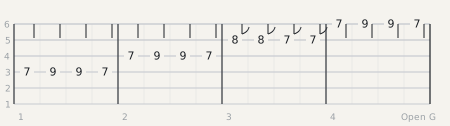
Bar 3 moves to the second string and plays two eighths on fret 8 followed by two on fret 7, which is a semitone slide rather than a whole tone. Semitone slides are harder to control because there is less distance to correct a wrong landing, so slow this bar down before joining it to the rest.
Bar 4 finishes on the first string with the two-fret slide played as quarter notes. Let the last note ring against an open fifth string plucked softly with the thumb — the combination of a fifth and a root an octave apart is the sound of the tuning itself.
Practice block · Bars 3–4 · 76 BPM
The staff scrolls sideways. Point at a bar, or tab to one and use the arrow keys, to cue it.
| Pattern | Left | Right | What to listen for |
|---|---|---|---|
| Whole-tone slide | 1 → 3 | ↓ (pick once) | One pick for two notes. Keep the fingertip pressed through the whole slide. |
| Semitone slide | 2 → 1 | ↓ ↑ | String 2, fret 8 to 7. Half the distance, twice the precision needed. |
| Drone under the phrase | none | p (thumb) | Open fifth string, played softly, left to decay under the slide. |
Questions
Do I need a slide (the metal bar) to play this?
No. These phrases are written for fingers, which is why the tab says exactly where to press. Playing them with a metal or glass slide is possible but changes the technique completely: with a bar you play over the fret rather than behind it, and the pressure has to be light enough to avoid pressing the strings into the board.
Which strings should the open drone be on?
The fifth string open is the safest drone because it is the root of the tuning and sits low enough not to crowd the melody. Pluck it with the thumb, lightly, and let it decay while the slide phrase happens on the top two strings.
Terms used in this lesson
Slide (portamento)滑音(Slide)
Moving a pressed finger along a string so the pitch travels continuously between two notes. Only the first note is picked; the destination note is produced by the finger's continued pressure during the travel. A slide played with released pressure loses the arrival note entirely.
Open string空弦(不按品)
A string played without pressing any fret, written as 0 in tab. Open strings ring longer and sound brighter than fretted notes because the whole string length vibrates, and they cannot be bent by the left hand — which is why phrases that need expression avoid landing on them.
Tablature六线谱(TAB)
Notation that shows music as six lines, one per string, with numbers indicating which fret to press. Tab says nothing directly about pitch or duration — both have to be inferred from the tuning and the rhythm stems — but it removes the need to translate a written note into a fret before playing it.
Shifting换把(Shift)
Moving the left hand from one position to another during a phrase. A shift can be audible, with the fingertip sliding along the string and connecting the two positions, or silent, with the hand arriving before the next note is played — but an unplanned gap between the two is audible as a mistake.
Plate files (SVG)
Fretboard matrix plate · Tab staff plate
/img/fret-open-g-slide-phrases.svg · /img/tab-open-g-slide-phrases.svg