G major across frets 7–9: a full position, both octaves
Fretquest · Scale map · Band III · intermediate
G 大调在 7–9 品:一个完整的把位、两个八度
- Tuning
- Standard E A D G B E
- Fret window
- Frets 7–9
- Scale
- G major (Ionian)
- Root
- G
- Tempo
- 72 BPM
- Difficulty
- 3 / 5 · intermediate
The window string by string
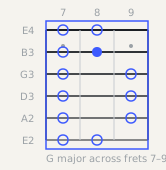
G major is G, A, B, C, D, E and F sharp. Inside frets 7 to 9 the playable notes are: string 6 fret 7 (B) and fret 8 (C); string 5 fret 7 (E) and fret 9 (F sharp); string 4 fret 7 (A) and fret 9 (B); string 3 fret 7 (D) and fret 9 (E); string 2 fret 7 (F sharp) and fret 8 (G); string 1 fret 7 (B) and fret 8 (C).
Only one root is inside the window: string 2 fret 8. Everything else is a degree of G in one of two octaves, which means the position is really two overlapping halves — the lower octave on strings 6, 5 and 4, the upper octave on strings 3, 2 and 1. Playing across the boundary between them is where the shape gets interesting.
- String 6: fret 7 = B (3), fret 8 = C (4)
- String 5: fret 7 = E (6), fret 9 = F sharp (7)
- String 4: fret 7 = A (2), fret 9 = B (3)
- String 3: fret 7 = D (5), fret 9 = E (6)
- String 2: fret 7 = F sharp (7), fret 8 = G (root)
- String 1: fret 7 = B (3), fret 8 = C (4)
Fret 8 is the odd one out
Notice how fret 8 appears only on two strings: string 6, where it gives C, and string 2, where it gives the root G. Everywhere else in the window, fret 8 falls outside G major. That makes fret 8 both the least-used and the most important fret in the position — one of its two notes is the tonic.
A useful exercise is to play only the fret-8 notes: string 6 fret 8, then string 2 fret 8, and back. Two notes, an octave and a bit apart, and they are the fourth and the root of the key. Hearing them alone makes it obvious why the shape has a hole in the middle.
- Play the position ascending from string 6 fret 7 to string 1 fret 8, naming each degree aloud.
- Play it descending, keeping the ring finger curved on fret 9.
- Play only the fret-7 notes in one pass, then only the fret-8 notes.
- Finally play fret 7 and 9 on each string as alternating pairs.
Four bars that climb the position
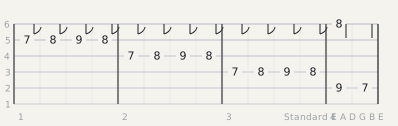
The tab takes one string per bar, starting on the second string and moving down to the fourth, then finishing with a two-note reach on the fifth string and a final C on the first. Each bar is a four-note ascending cell in eighth notes followed by a step back down, which is the most compact way to cover a three-fret window without a shift.
Play at 72 BPM. The awkward moment is the start of bar 3 on the fourth string, where the pinky has to reach fret 9 while the index stays on fret 7 — the finger span is a full tone wider than anything in the pentatonic shapes you may have learned first.
Practice block · Bars 1–4 · 72 BPM
The staff scrolls sideways. Point at a bar, or tab to one and use the arrow keys, to cue it.
| Pattern | Left | Right | What to listen for |
|---|---|---|---|
| One string per bar | 2-3-4 | i m i m | Ascending four-note cell then a step back down. Ring finger does the fret-9 work. |
| Fret-8 only | 2 | m | String 6 fret 8 then string 2 fret 8. The fourth degree and the root, nothing else. |
| Widest reach | 1 → 4 | m i | Bar 3 on string 4: index on fret 7, pinky on fret 9, middle finger stays relaxed. |
Questions
Why does the position start on the second string rather than the sixth?
Because the exercise is written to keep every bar inside the three-fret window on one string. The sixth string's notes in this position are B and C, which sit a long way below the rest of the shape; starting on the second string keeps the four bars in one register so the finger pattern is easier to compare from bar to bar.
How long should it take to learn a full-position scale like this?
Two to three weeks of short daily sessions, not one long session. A full position has roughly twice the note count of a pentatonic box, and the memory work is spread across the neck rather than clustered, so short repetitions at a slow tempo beat long ones at speed.
Terms used in this lesson
Scale degree音阶级数(Scale degree)
The number a scale note occupies when the scale is counted from its root upward: 1 for the root, 2 for the next note, and so on. A prefix of b lowers the degree by a semitone and # raises it, so b3 means the third degree flattened — the note that makes a minor pentatonic sound minor.
Position playing把位演奏(Position)
Playing with the hand parked at one place on the neck, so that the index finger covers one fret and the other fingers cover the frets above it. Positions are numbered by the fret the index finger sits on: first position puts the index at fret 1, second position at fret 2, and so on.
Fret marker品位标记(点)
The inlay dots on the fretboard, placed at frets 3, 5, 7, 9, 12, 15 and above. Markers are landmarks for the left hand when shifting and for the eye when reading: the double dot at fret 12 marks the octave, and knowing where it is keeps the hand from drifting a fret sharp or flat.
Root note根音(第一级音)
The note a scale or chord is named after and the note the music resolves to. In a scale diagram the root is marked differently from every other degree because it is the pitch the ear hears as home, and phrases that end on it sound finished while phrases that end elsewhere sound suspended.
Plate files (SVG)
Fretboard matrix plate · Tab staff plate
/img/fret-g-major-scale-across-third-position.svg · /img/tab-g-major-scale-across-third-position.svg