Reading ties, held notes and repeated bars
Fretquest · Technique · Band III · building
读懂延音线、保持音与反复记号
- Tuning
- Standard E A D G B E
- Fret window
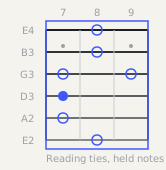
- Frets 7–9
- Scale
- A minor pentatonic
- Root
- A
- Tempo
- 60 BPM
- Difficulty
- 2 / 5 · building
The stem carries the rhythm
Every bar of tab on this site is labelled with its stem: q for quarter notes, e for eighth notes, s for sixteenths. A quarter note lasts one beat, an eighth lasts half a beat, a sixteenth a quarter of a beat. The fret numbers themselves say nothing about duration — two bars of tab with the same frets can be a slow ballad or a fast run depending only on the stems.
That is why the same figure appears at several tempos across these lessons. Frets 7 and 9 on the third string are the same two pitches at every tempo; what changes is how much time each one occupies.
- q — one note per beat (quarter note)
- e — two notes per beat (eighth note)
- s — four notes per beat (sixteenth note)
- A bar of 4/4 holds four quarter notes, eight eighths, or sixteen sixteenths
Ties and held notes
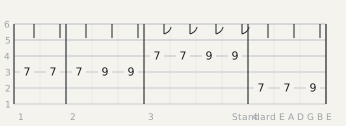
A tie joins two written notes of the same pitch into one longer sound. In tab it appears as a curved line between two identical fret numbers: you press the fret once and hold it through both counts. Bar 1 of the tab uses this to make a note last two beats, and bar 2 does the same with a three-note figure that holds its final note.
The practical mistake is to re-pick the second note of a tie. That turns a held note into two notes and destroys the phrase shape — an error that is easy to make and easy to hear, because the second attack lands where the music should be sustaining.
- Count four beats per bar out loud at 60 BPM.
- Play bar 1 pressing fret 7 once and holding it for two counts.
- Do not re-pick on count two; listen for the sound to continue.
- Repeat with bar 2 and hold the final fret 9 for two counts.
Practice block · Bars 1–2 · 60 BPM
The staff scrolls sideways. Point at a bar, or tab to one and use the arrow keys, to cue it.
Bars 3 and 4 — repeats and the closing figure
Bar 3 uses eighth notes on the fourth string, alternating frets 7 and 9 — a whole tone apart, the interval that appears in almost every phrase in this position. Bar 4 moves to the fifth string with a three-note figure that ends on fret 9 and is held.
When a bar is marked as repeated, the frets are the same but the second pass is usually played slightly differently — softer, or with a small dynamic lift — because a literal repeat sounds mechanical. The dots on the fretboard do not change between passes; only the player's intention does.
Practice block · Bars 3–4 · 60 BPM
The staff scrolls sideways. Point at a bar, or tab to one and use the arrow keys, to cue it.
| Pattern | Left | Right | What to listen for |
|---|---|---|---|
| Held note | 1 (held) | p twice, then none | Press once, hold for two counts, do not re-pick. |
| Eighth-note alternation | 1-3 | i m i m | Frets 7 and 9 on the fourth string. Keep both fingers close to the fretboard. |
| Repeat pass | same | same | Second time through, play it a little softer — the notes are identical, the intent is not. |
Questions
How do I know how long to hold a note in tab?
From the rhythm notation, not the numbers. A tab number says which fret and string; the stem attached to it says how long. If you are reading tab without stems, you are reading a fingering chart rather than a piece of music, which is fine for learning a shape and useless for playing in time.
What is the difference between a tie and a slur?
A tie joins two notes of the same pitch into one sound. A slur joins two notes of different pitches, indicating a hammer-on, pull-off or slide rather than a separate pick stroke. In tab the two look similar — a curved line between numbers — so the tell is whether the numbers are the same or different.
Terms used in this lesson
Tab stem谱音符干(时值)
The rhythm marking attached to a bar of tab: q for quarter notes, e for eighth notes, s for sixteenth notes. The fret numbers say which notes to play and the stem says how long each lasts, so the same fret numbers with a different stem are a different piece of music.
Tablature六线谱(TAB)
Notation that shows music as six lines, one per string, with numbers indicating which fret to press. Tab says nothing directly about pitch or duration — both have to be inferred from the tuning and the rhythm stems — but it removes the need to translate a written note into a fret before playing it.
Fret wire品丝(指板横条)
The metal strip set into the fretboard that the string contacts to produce a note. Pressing just behind a fret wire gives a clean note; pressing on top of the wire or halfway between two wires produces a buzz or a note that is out of tune, which is the usual cause of a chord that will not ring clearly.
Position playing把位演奏(Position)
Playing with the hand parked at one place on the neck, so that the index finger covers one fret and the other fingers cover the frets above it. Positions are numbered by the fret the index finger sits on: first position puts the index at fret 1, second position at fret 2, and so on.
Plate files (SVG)
Fretboard matrix plate · Tab staff plate
/img/fret-reading-ties-dots-and-repeat-signs.svg · /img/tab-reading-ties-dots-and-repeat-signs.svg