E harmonic minor in fifth position
Fretquest · Scale map · Band V · upper register
E 和声小调 · 第 V 把位
- Tuning
- Standard E A D G B E
- Fret window
- Frets 13–15
- Scale
- E harmonic minor
- Root
- E
- Tempo
- 54 BPM
- Difficulty
- 5 / 5 · upper register
Ten dots, one root, one augmented second
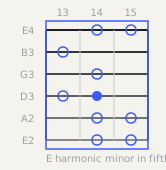
The window contains: string 6 fret 14 (F sharp) and fret 15 (G); string 5 fret 14 (B) and fret 15 (C); string 4 fret 13 (D sharp) and fret 14 (E, the root); string 3 fret 14 (A); string 2 fret 13 (C); string 1 fret 14 (F sharp) and fret 15 (G). Ten dots and one root, on the fourth string at fret 14.
The awkward part is the sixth-to-seventh move. C is at fret 15 on the fifth string and D sharp is at fret 13 on the fourth string — the two notes are on different strings and two frets apart, so the augmented second cannot be played on one string anywhere in this window. It has to be crossed, and the fingering for that crossing is the whole lesson.
- String 6: fret 14 = F sharp (2), fret 15 = G (3)
- String 5: fret 14 = B (5), fret 15 = C (6)
- String 4: fret 13 = D sharp (7), fret 14 = E (root)
- String 3: fret 14 = A (4)
- String 2: fret 13 = C (6)
- String 1: fret 14 = F sharp (2), fret 15 = G (3)
Why the raised seventh exists
Natural minor has a seventh degree that sits a whole tone below the root, which makes a weak leading tone: the ear does not feel pulled strongly back to the tonic. Raising it a semitone gives a note that is a half step below the root, and that half step is what makes a minor-key cadence sound final.
The cost is the augmented second — three semitones where the ear expects two. In E harmonic minor that gap is between C and D sharp, and it appears twice in the scale, ascending and descending. Playing it slowly and letting it sound exotic is the fastest way to internalise it; trying to smooth it out defeats the point of the scale.
- Play string 5 fret 15, then string 4 fret 13, slowly. That is C to D sharp — three semitones.
- Play the same pair descending and listen for the same gap.
- Play the full window ascending and stop on every D sharp.
- Finish by playing string 4 fret 13 to fret 14 and hold the root.
Four bars in the high register
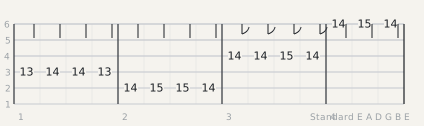
Bar 1 walks the third string up from fret 13 to 15 and back, which is A, a semitone, and B flat in pitch terms — B flat is not in E harmonic minor, so fret 14 on the third string is A and fret 15 is out of the key. The figure deliberately steps outside for one note and returns, which is how the scale's shape is felt rather than merely memorised.
Bar 2 moves to the fifth string, bar 3 descends the fourth string in eighth notes, and bar 4 finishes on the first string with three quarter notes ending on fret 14 — the second degree, unresolved. Keep the tempo at 54 BPM: harmonic minor at this position is a stretch for the third and fourth fingers, and speed training on a scale you cannot yet hear is wasted work.
Practice block · Bars 1–4 · 54 BPM
The staff scrolls sideways. Point at a bar, or tab to one and use the arrow keys, to cue it.
| Pattern | Left | Right | What to listen for |
|---|---|---|---|
| The augmented second | 3 (string 5) → 1 (string 4) | m i | C to D sharp. Three semitones across two strings — the crossing is the exercise. |
| Root arrival | 2 | m | String 4 fret 14. The only root in the window; hold it a full bar. |
| Out and back | 2-3-4 | i m i | Bar 1 steps to fret 15 and back; the outside note should sound outside. |
Questions
Why is harmonic minor harder than natural minor?
Because of the augmented second and the stretch it creates. In natural minor every adjacent pair of scale notes is one or two frets apart; in harmonic minor the six-to-seven move is three semitones, which in most positions means moving between strings or stretching. The sound is also unfamiliar to players raised on pentatonic and modal playing.
When is harmonic minor actually used?
It is the scale behind most minor-key classical harmony and a great deal of neo-classical and metal soloing, because the raised seventh produces the dominant chord of the minor key. Whenever a minor piece uses a major-five chord — Am followed by E major, for example — the melodic material is harmonic minor.
Terms used in this lesson
Scale degree音阶级数(Scale degree)
The number a scale note occupies when the scale is counted from its root upward: 1 for the root, 2 for the next note, and so on. A prefix of b lowers the degree by a semitone and # raises it, so b3 means the third degree flattened — the note that makes a minor pentatonic sound minor.
Position playing把位演奏(Position)
Playing with the hand parked at one place on the neck, so that the index finger covers one fret and the other fingers cover the frets above it. Positions are numbered by the fret the index finger sits on: first position puts the index at fret 1, second position at fret 2, and so on.
Fingering指法(左右手安排)
The plan for which finger plays which note, in both hands. Fingering is not fixed by the notes: the same passage can be played several ways, and the choice depends on what comes before and after, on which strings the phrase lands, and on whether the player wants a legato or a picked sound.
Fret wire品丝(指板横条)
The metal strip set into the fretboard that the string contacts to produce a note. Pressing just behind a fret wire gives a clean note; pressing on top of the wire or halfway between two wires produces a buzz or a note that is out of tune, which is the usual cause of a chord that will not ring clearly.
Plate files (SVG)
Fretboard matrix plate · Tab staff plate
/img/fret-e-harmonic-minor-fifth-position.svg · /img/tab-e-harmonic-minor-fifth-position.svg