Building speed with a tempo ladder
Fretquest · Technique · Band V · building
用速度阶梯练速度
- Tuning
- Standard E A D G B E
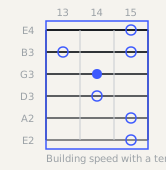
- Fret window
- Frets 13–15
- Scale
- A minor pentatonic
- Root
- A
- Tempo
- 60 BPM
- Difficulty
- 2 / 5 · building
How a ladder works
Pick a short passage — one bar, no more. Set the metronome to a tempo where you can play it perfectly ten times in a row. That is the base. Play the passage ten times, and only if all ten were clean, raise the tempo by four BPM and repeat. If any of the ten is not clean, do not raise: stay at that tempo for another ten.
The rule that makes this work is the refusal to move on. Most players raise the tempo after one good pass and then spend the next session playing sloppily at a speed they have not earned. The ladder treats a tempo as owned only when ten consecutive passes are clean, which sounds slow and is in fact the fastest reliable path.
- One bar only — a passage short enough to hear every note
- Ten clean passes at the current tempo before any increase
- Increase by four BPM, never more
- If two increases in a row fail, drop back two rungs and rebuild
Bars 1 and 2 at the base tempo
Bar 1 is four quarter notes on the third string at fret 14, one note per click. This is deliberately the easiest bar in the study: at 60 BPM it should be perfect on the first attempt, which makes it the correct place to start the ladder and the correct place to return to when a higher tempo collapses.
Bar 2 doubles the density to eighth notes, adds fret 15, and is played on the second string — three changes at once. The ladder should be climbed on bar 1 first, then on bar 2 from a tempo low enough to make it easy, which for most players is around 52 BPM.
- Set the metronome to 60 BPM and play bar 1 ten times.
- If all ten are clean, go to 64 BPM and repeat.
- Move to bar 2, start at 52 BPM, and climb the same way.
- Record yourself at the tempo where it first falls apart and listen to why.
Practice block · Bars 1–2 · 60 BPM
The staff scrolls sideways. Point at a bar, or tab to one and use the arrow keys, to cue it.
Bars 3 and 4 — where the ladder finds the limit
Bar 3 alternates frets 13 and 15 on the second string in eighth notes, which is a two-fret jump with an alternate-picked right hand — the coordination between a wide left-hand move and a strict down-up pattern is what usually breaks first. Bar 4 finishes with three quarter notes on the fourth string and a held note.
Expect the ladder on bar 3 to stop earlier than the others, and do not treat that as a failure. Every passage has its own ceiling, and the point of the exercise is to know what your ceiling is today rather than to reach some target tempo. Tomorrow the ceiling will be a few BPM higher, and that movement is the entire result.
Practice block · Bars 3–4 · 60 BPM
The staff scrolls sideways. Point at a bar, or tab to one and use the arrow keys, to cue it.
| Pattern | Left | Right | What to listen for |
|---|---|---|---|
| Base tempo bar | 2-2-2-2 | ↓ ↑ ↓ ↑ | Bar 1 at 60 BPM. This is the rung you climb onto and fall back to. |
| Density double | 2-3 | ↓ ↑ | Bar 2 at 52 BPM: eighth notes, fret 15 added, new string. Change one variable at a time. |
| Two-fret jump | 1-3 | ↓ ↑ | Bar 3 alternates frets 13 and 15 — the leap is where the tempo ladder stops. |
Questions
How long should I stay on one tempo?
Until ten consecutive passes are clean. That might be two minutes at a tempo you already own and twenty at one you are just reaching. Time is not the measure; the ten clean passes are. Counting passes rather than minutes also keeps the practice honest, because it removes the temptation to call a shaky run good enough.
Why four BPM and not ten?
Because ten BPM is a large enough jump to break the playing without telling you what broke. Four BPM is small enough that a failure is attributable to a specific movement — usually one string crossing or one finger change — and that specific fault is what you then practise at the lower tempo.
Terms used in this lesson
Tempo ladder速度阶梯(Tempo ladder)
A practice method that raises the metronome in small steps — usually four BPM — and only after a fixed number of consecutive clean repetitions. The ladder makes the current ceiling explicit and turns speed into a measured result of accuracy rather than something attempted directly.
Metronome节拍器(Metronome)
A steady click at a fixed tempo, measured in beats per minute. The metronome does not make playing faster; it reveals where the playing stops matching the beat, which is the information you need before speed can be added at all. Practising without one usually means practising the same errors.
Alternate picking交替拨弦(上下交替)
Strictly alternating down and up strokes with the pick, one stroke per note. Alternate picking gives even rhythm and high attainable speed once the up stroke is as strong as the down, but it forces a change of stroke direction at every string crossing, which is where most players lose time.
Plectrum拨片(Pick)
The pick, held between thumb and index finger with only a small tip protruding. How much tip is exposed controls the tone as much as the pick's thickness: a small tip produce a tighter, more controlled attack and less pick noise against the strings, while a large tip produces a louder, sloppier one.
Plate files (SVG)
Fretboard matrix plate · Tab staff plate

/img/fret-tempo-ladder-metronome-speed-building.svg · /img/tab-tempo-ladder-metronome-speed-building.svg