F major in second position on the low strings
Fretquest · Scale map · Band II · intermediate
F 大调在第 II 把位的低音弦上
- Tuning
- Standard E A D G B E
- Fret window
- Frets 4–6
- Scale
- F major (Ionian)
- Root
- F
- Tempo
- 64 BPM
- Difficulty
- 3 / 5 · intermediate
Where the B flat lives in this window
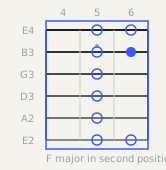
Inside frets 4 to 6 the F major notes on the low strings are: string 6 fret 5 (A) and fret 6 (B flat); string 5 fret 5 (D) and fret 6 (E); string 4 fret 5 (G); string 3 fret 5 (C); string 2 fret 5 (E) and fret 6 (F). The B flat is on string 6 fret 6, which is the only flat in the whole window and the note most likely to be played sharp by a player who has only worked in sharp keys.
Since the sixth string's open note is E and its first fret is F, the whole of frets 4 to 6 on that string is a short climb through G, A and B flat. Playing those three notes slowly and listening for the B flat is worth more than playing the whole scale quickly.
- String 6: fret 5 = A (3), fret 6 = B flat (4)
- String 5: fret 5 = D (6), fret 6 = E (7)
- String 4: fret 5 = G (2)
- String 3: fret 5 = C (5)
- String 2: fret 5 = E (7), fret 6 = F (root)
- Below fret 4, string 6 fret 3 = G is out of the key; the scale continues on the open strings instead
Flat keys and the shape of the hand
F major in this position uses frets 4, 5 and 6 with almost no stretching: the index covers fret 4, the middle fret 5 and the pinky fret 6, and the ring finger is barely used. That is a different feel from G major in the same frets, where the pattern of which string gets the pinky is more irregular.
The practical difficulty is not the fingers, it is the ear. Most players arrive at F major having played C, G, D and A major, all of which are sharp keys, and the ear is trained to expect a natural B. Play the scale slowly and stop every time you reach B flat; hold it and let it sound wrong before continuing. Two minutes of that does more than an hour of running the scale.
- Play only frets 5 and 6 on string 6 as quarter notes at 64 BPM, saying A and B flat aloud.
- Add the fifth string pair (D and E) and continue.
- Play the whole window ascending and stop on every B flat.
- Finish with the descending run, listening for the flat to be in tune.
Four bars through the low strings
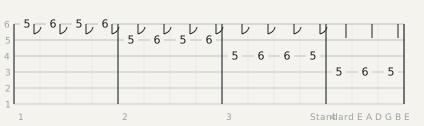
The tab keeps every bar on one string and uses only frets 5 and 6, which makes it a pure two-note-per-string study — the rhythmic equivalent of a metronome exercise but with real pitches. Bar 4 closes on the third string with three quarter notes and a held C.
Because the pattern is so repetitive, any unevenness in the descent is instantly audible. Record the four bars and listen for the bar where the second note of each pair is consistently late: that is the bar where your finger is preparing for the next string instead of finishing the note it is on.
Practice block · Bars 1–4 · 64 BPM
The staff scrolls sideways. Point at a bar, or tab to one and use the arrow keys, to cue it.
| Pattern | Left | Right | What to listen for |
|---|---|---|---|
| Two-note pair on string 6 | 2-3 | i m | A to B flat. Say the names aloud; the second note must not drift sharp. |
| Descending run | 3-2 | m i | The second note of each pair tends to arrive late — finish the note you are on first. |
| Flat-key ear check | 3 | m | Hold string 6 fret 6 and let it sound; the note should be a semitone below the open second string. |
Questions
Why is B flat so hard to hear after playing in sharp keys?
Because your ear has been calibrated by scales where the fourth degree is a natural. In F major the fourth degree is B flat, and it sits a semitone lower than the B natural your ear expects — which is why the note sounds like a mistake the first few times, even when it is perfectly in tune.
Do I need to know the note names to play in a flat key?
You need to know one: which note in the position is the flat. Everything else can be played by shape. In this window that one note is string 6 fret 6, and once you can find it without thinking the key stops feeling foreign.
Terms used in this lesson
Scale degree音阶级数(Scale degree)
The number a scale note occupies when the scale is counted from its root upward: 1 for the root, 2 for the next note, and so on. A prefix of b lowers the degree by a semitone and # raises it, so b3 means the third degree flattened — the note that makes a minor pentatonic sound minor.
Position playing把位演奏(Position)
Playing with the hand parked at one place on the neck, so that the index finger covers one fret and the other fingers cover the frets above it. Positions are numbered by the fret the index finger sits on: first position puts the index at fret 1, second position at fret 2, and so on.
Root note根音(第一级音)
The note a scale or chord is named after and the note the music resolves to. In a scale diagram the root is marked differently from every other degree because it is the pitch the ear hears as home, and phrases that end on it sound finished while phrases that end elsewhere sound suspended.
Fret marker品位标记(点)
The inlay dots on the fretboard, placed at frets 3, 5, 7, 9, 12, 15 and above. Markers are landmarks for the left hand when shifting and for the eye when reading: the double dot at fret 12 marks the octave, and knowing where it is keeps the hand from drifting a fret sharp or flat.
Plate files (SVG)
Fretboard matrix plate · Tab staff plate
/img/fret-f-major-scale-second-position-low-strings.svg · /img/tab-f-major-scale-second-position-low-strings.svg