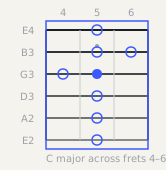
C major across frets 4–6: the second-position shape
Fretquest · Scale map · Band II · building
C 大调在 4–6 品:第 II 把位形状
- Tuning
- Standard E A D G B E
- Fret window
- Frets 4–6
- Scale
- C major (Ionian)
- Root
- C
- Tempo
- 66 BPM
- Difficulty
- 2 / 5 · building
Reading the dots from string 6 upward
In frets 4 to 6 with standard tuning the C major notes available are: string 6 fret 5 (A) and fret 6 (A sharp is not in the key, so fret 5 and the open string below it are the only options there); string 5 fret 5 (D) and fret 6 (D sharp, also outside); string 4 fret 5 (G) and fret 6 (G sharp, outside); string 3 fret 5 (C) and fret 6 (C sharp, outside — but fret 4 gives you B); string 2 fret 5 (E) and fret 6 (F); string 1 fret 5 (A) and fret 6 (A sharp, outside).
The useful way to read that is not as a list of exclusions but as a map: within the window, frets 4 and 5 carry almost all of the scale, and fret 6 is only used on the second and first strings, where it gives F. That is why the drill below ends on string 2 fret 6 rather than on the top string.
- String 6: fret 5 = A (degree 6)
- String 5: fret 5 = D (degree 2); fret 4 = C sharp is out of key, use fret 3 or the open string instead
- String 4: fret 4 = B (degree 7); fret 5 = G (degree 5)
- String 3: fret 5 = C (root); fret 4 = B (degree 7)
- String 2: fret 5 = E (degree 3); fret 6 = F (degree 4)
- String 1: fret 5 = A (degree 6); fret 4 = G sharp is out of key
Why the pinky takes fret 6
Fret 6 only appears on the second string in this shape, and it is a whole tone above fret 5 on the same string. If you play it with the ring finger your hand has to rotate to reach across, which pulls the other three fingertips off their notes. Assigning fret 6 to the pinky keeps the hand square: index on 4, middle on 5, pinky on 6, and nothing moves when you switch strings.
That gives the familiar 1-2-4 fingering pattern of second position. The ring finger is deliberately left out of this window; it becomes useful one position higher, where stretches of a whole tone between fret 5 and fret 7 are common.
- Place the index on string 5 fret 4, middle on frets 5, pinky on fret 6.
- Play only the notes that exist: string 5 fret 5, string 4 fret 4, string 4 fret 5, string 3 fret 4, string 3 fret 5, string 2 fret 5, string 2 fret 6.
- Say the degree number of each note as you play it, not the note name — degrees transfer to other keys, names do not.
Four-bar drill and the hand-off back down
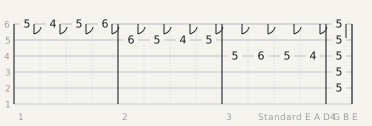
Bars 1 to 3 of the tab climb one string per bar in eighth notes, working from the low E up to the third string. Bar 4 turns around and plays the same C on four different strings — string 2 fret 5, string 3 fret 5, string 4 fret 5 and string 5 fret 5 — as quarter notes. Hearing the same pitch on four strings is the fastest way to learn which frets duplicate which pitches on a standard-tuned guitar.
Keep the tempo at 66 BPM until bar 4 is even. The turnaround bar is where players rush, because the fretting hand has nothing to do while the picking hand changes string four times in a row.
Practice block · Bars 1–4 · 66 BPM
The staff scrolls sideways. Point at a bar, or tab to one and use the arrow keys, to cue it.
| Pattern | Left | Right | What to listen for |
|---|---|---|---|
| One string per bar | 2-1-2-4 | i m i m | Middle on fret 5, index on fret 4, pinky on fret 6. No ring finger anywhere in this shape. |
| Same pitch, four strings | 2 | m | C on string 2 fret 5, string 3 fret 5, string 4 fret 5, string 5 fret 5. Listen for the pitch to stay put. |
| Degree naming | 1-2-4 | i m i | Say 6-7-1-2-3-4-5 as you climb; the degree, not the note name. |
Questions
Why does the shape avoid the ring finger completely?
Because in a three-fret window there are only three frets to cover and the index-middle-pinky set spans them without a rotation. The ring finger joins as soon as the window widens to four frets, which is the standard shape of third position: 1-2-3-4 across frets 5, 6, 7 and 8.
Should I shift the whole shape up two frets to play D major?
You can, and the fingering carries over exactly — D major in frets 6 to 8 uses the same 1-2-4 pattern. What does not carry over is the set of strings that use fret 6: the pattern of which string gets the pinky note changes with the key, so re-read the dots rather than assuming the shape is identical.
Terms used in this lesson
Position playing把位演奏(Position)
Playing with the hand parked at one place on the neck, so that the index finger covers one fret and the other fingers cover the frets above it. Positions are numbered by the fret the index finger sits on: first position puts the index at fret 1, second position at fret 2, and so on.
Shifting换把(Shift)
Moving the left hand from one position to another during a phrase. A shift can be audible, with the fingertip sliding along the string and connecting the two positions, or silent, with the hand arriving before the next note is played — but an unplanned gap between the two is audible as a mistake.
Scale degree音阶级数(Scale degree)
The number a scale note occupies when the scale is counted from its root upward: 1 for the root, 2 for the next note, and so on. A prefix of b lowers the degree by a semitone and # raises it, so b3 means the third degree flattened — the note that makes a minor pentatonic sound minor.
Fingering指法(左右手安排)
The plan for which finger plays which note, in both hands. Fingering is not fixed by the notes: the same passage can be played several ways, and the choice depends on what comes before and after, on which strings the phrase lands, and on whether the player wants a legato or a picked sound.
Plate files (SVG)
Fretboard matrix plate · Tab staff plate
/img/fret-c-major-scale-in-second-position.svg · /img/tab-c-major-scale-in-second-position.svg