Slide technique on a single string
Fretquest · Technique · Band II · building
单弦上的滑音技术
- Tuning
- Standard E A D G B E
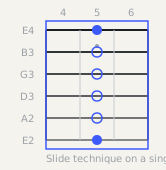
- Fret window
- Frets 4–6
- Scale
- A minor pentatonic
- Root
- A
- Tempo
- 66 BPM
- Difficulty
- 2 / 5 · building
Pick once, hear two notes
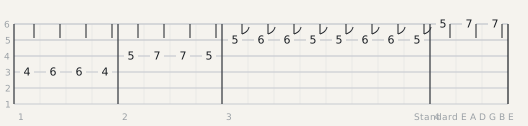
The defining feature of a slide is that only the first note is plucked. Everything after it comes from the finger moving with pressure applied. In bar 1 of the tab, string 3 frets 4 and 6 are connected twice, and each pair is one pick stroke: the finger lands on fret 4, is picked, then slides to fret 6 and back to 4 without any further right-hand involvement.
That means the second note's volume depends entirely on how much pressure the finger maintained during the slide. A slide played with light pressure produces an almost inaudible arrival note; a slide played with full pressure produces a clear one. The difference is entirely in the left hand.
- One pick stroke per slide pair — the right hand plays half as often as it sounds
- Start the slide from a fretted note, never from an open string
- Keep the fingertip pressed for the whole travel, including the arrival
- Vary the speed of the travel: fast slides sound aggressive, slow ones sound vocal
Bars 1 and 2 — one whole tone each way
Bar 1 slides between frets 4 and 6 on the third string, which is a whole tone: B up to C sharp. Bar 2 does the same on the fourth string, sliding between frets 5 and 7. Both bars play the slide twice — up and back — as quarter notes, so at 66 BPM each slide takes half a second, which is slow enough to hear any wobble in the pitch as it travels.
Listen for the pitch to move continuously. If it jumps, the finger is not maintaining contact with the fretboard; if it disappears, the pressure has dropped.
- Play the first slide in bar 1 very slowly with the picking hand ready but idle.
- Listen for continuous pitch movement from fret 4 to fret 6.
- Slide back down and let the original note ring out.
- Repeat until both directions sound identical in volume.
Practice block · Bars 1–2 · 66 BPM
The staff scrolls sideways. Point at a bar, or tab to one and use the arrow keys, to cue it.
Bars 3 and 4 — slides inside a running line
Bar 3 puts eight slides in one bar of eighth notes on the second string, alternating frets 5 and 6, so the tune becomes a continuous glide rather than a series of separate notes. This is the version that exposes an inconsistent left hand: any variation in pressure shows up as a variation in volume between slide pairs.
Bar 4 finishes on the first string with three quarter notes, the last of which is held. At 66 BPM these four bars take under eight seconds, and they are worth playing eight times in a row — the technique is small enough that fatigue is not a factor, and the repetition is what makes the pressure consistent.
Practice block · Bars 3–4 · 66 BPM
The staff scrolls sideways. Point at a bar, or tab to one and use the arrow keys, to cue it.
| Pattern | Left | Right | What to listen for |
|---|---|---|---|
| Slide up and back | 1 → 3 → 1 | ↓ (once) | One pick for the whole pair. Keep full pressure through the arrival. |
| Eighth-note glides | 2 (sliding) | ↓ ↑ ↓ ↑ | Bar 3 alternates frets 5 and 6; the tune should never stop moving. |
| Pressure test | 1 | — | Slide with no pick at all. Any sound you hear at the destination comes purely from left-hand pressure. |
Questions
How is a slide different from a shift?
In a shift the movement is silent and the destination note is picked separately; in a slide the movement itself is the sound and the destination note is not picked at all. Players often confuse them because the hand does the same thing — but one wants released pressure and the other wants full pressure.
Can I slide with any finger?
Yes, and each finger produces a slightly different tone because of the angle of approach. The index and middle fingers are both common; the ring finger is used for slides that arrive at a higher fret without a hand shift. Beginners usually start with the index and add the others once the pressure control is reliable.
Terms used in this lesson
Slide (portamento)滑音(Slide)
Moving a pressed finger along a string so the pitch travels continuously between two notes. Only the first note is picked; the destination note is produced by the finger's continued pressure during the travel. A slide played with released pressure loses the arrival note entirely.
Shifting换把(Shift)
Moving the left hand from one position to another during a phrase. A shift can be audible, with the fingertip sliding along the string and connecting the two positions, or silent, with the hand arriving before the next note is played — but an unplanned gap between the two is audible as a mistake.
Legato连奏(Legato)
Playing with hammer-ons, pull-offs and slides instead of separate pick strokes, so that notes are joined rather than articulated individually. Legato produces a smooth, singing line and demands more of the left hand, because every note's volume and clarity now depends on finger pressure rather than the pick.
Anchor finger锚指(固定手指)
A finger that stays pressed on one note while the others move around it. Anchoring reduces the amount of movement the hand has to make, keeps the hand oriented when the shape is unfamiliar, and gives the ear a fixed pitch to measure every other note against.
Plate files (SVG)
Fretboard matrix plate · Tab staff plate
/img/fret-slide-technique-on-one-string.svg · /img/tab-slide-technique-on-one-string.svg