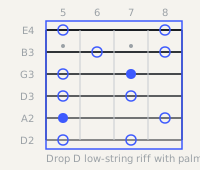
Drop D low-string riff with palm muting
Fretquest · Tab piece · Band II · building
Drop D 低音弦闷音连复段
- Tuning
- Drop D D A D G B E
- Fret window
- Frets 5–8
- Scale
- D minor pentatonic
- Root
- D
- Tempo
- 84 BPM
- Difficulty
- 2 / 5 · building
What changes when the sixth string drops to D
Tuning the sixth string down a whole tone from E to D changes the interval between the bottom two strings from a fourth to a fifth. Everything you knew about the low strings shifts with it: the octave of the sixth string is no longer at its twelfth fret relative to the fifth string's seventh, and any pattern that assumed a fourth between strings 6 and 5 now produces a different set of notes.
The practical gain is the open low D. It is a root note in the key of D, it can be played alone as a pedal, and it sits a fifth below the open fifth string, so the two lowest open strings form a D and an A — the two most useful notes in the key.
- String 6 open — D (root)
- String 6 fret 5 — G (fourth)
- String 6 fret 7 — A (fifth)
- String 5 open — A (fifth)
- String 5 fret 3 — C (flat seventh)
- Standard tuning is restored by raising the sixth string a whole tone; check it against the open fourth string's twelfth fret harmonic
Bars 1 and 2: the pedal and the answer
Bar 1 is a pedal figure: four strikes on the open sixth string, then two on fret 5, then two back on the open string. Bar 2 answers it with the same rhythm but moves to fret 7 before falling back to fret 5. Both bars are eighth notes with a palm mute applied except on the accented notes.
Rest the side of your picking hand lightly across the strings just in front of the bridge. Too far forward and the note dies completely; just behind the bridge saddles and the mute has no effect at all. The sweet spot produces a short, pitched thump — you should still be able to hear the pitch of the D, not just a click.
Practice block · Bars 1–2 · 84 BPM
The staff scrolls sideways. Point at a bar, or tab to one and use the arrow keys, to cue it.
Bars 3 and 4: moving the figure to the fifth string
Bar 3 transfers the same rhythm to the open fifth string with a reach up to fret 3, which gives C — the flat seventh, the note that makes the riff sound minor rather than modal. Bar 4 closes with three quarter notes on the sixth string: open, open, fret 5, letting the last note ring out unmuted.
The shift between the two strings is where most players lose the pulse, because the picking hand has to move across a string while maintaining the mute. Practise bar 2 into bar 3 as a single eight-bar loop at 84 BPM until the string change is inaudible.
Practice block · Bars 3–4 · 84 BPM
The staff scrolls sideways. Point at a bar, or tab to one and use the arrow keys, to cue it.
| Pattern | Left | Right | What to listen for |
|---|---|---|---|
| Open-string pedal | none | ↓ ↑ ↓ ↑ | Palm mute the open sixth string; the note should still have a pitch, not just a click. |
| Reach to fret 5 | 1 | ↓ | Index finger only. Keep the hand quiet — the fret hand moves, the arm does not. |
| Fifth-string transfer | 1-3 | ↓ ↑ | Bars 2 into 3: keep the mute on while the pick crosses strings. |
Questions
Will drop D tuning damage my guitar or the string?
No. A standard set of strings can be dropped a whole tone and brought back up repeatedly without harm; the tension change is small. The one habit worth avoiding is leaving the guitar in drop D for months at a time on a floating-bridge instrument, where the reduced tension will pull the bridge forward slightly.
How much distortion does this riff need?
Very little. The palm mute supplies the attack and the open low D supplies the weight, so a light overdrive or a clean amp with the volume up will read better than heavy distortion, which compresses the difference between the muted and unmuted notes and flattens the riff.
Terms used in this lesson
Palm mute掌闷音(Palm mute)
Resting the edge of the picking hand lightly on the strings just in front of the bridge saddles to shorten the note and cut its high frequencies. Moving the hand toward the bridge makes the mute lighter and the note longer; moving it away from the bridge kills the note entirely.
Alternate picking交替拨弦(上下交替)
Strictly alternating down and up strokes with the pick, one stroke per note. Alternate picking gives even rhythm and high attainable speed once the up stroke is as strong as the down, but it forces a change of stroke direction at every string crossing, which is where most players lose time.
Tablature六线谱(TAB)
Notation that shows music as six lines, one per string, with numbers indicating which fret to press. Tab says nothing directly about pitch or duration — both have to be inferred from the tuning and the rhythm stems — but it removes the need to translate a written note into a fret before playing it.
Fret wire品丝(指板横条)
The metal strip set into the fretboard that the string contacts to produce a note. Pressing just behind a fret wire gives a clean note; pressing on top of the wire or halfway between two wires produces a buzz or a note that is out of tune, which is the usual cause of a chord that will not ring clearly.
Plate files (SVG)
Fretboard matrix plate · Tab staff plate

/img/fret-drop-d-low-string-riff.svg · /img/tab-drop-d-low-string-riff.svg