Hybrid picking: holding a bass line under a melody
Fretquest · Technique · Band II · advanced
混合拨弦:在旋律之下保持一条低音线
- Tuning
- Standard E A D G B E
- Fret window
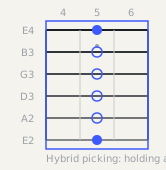
- Frets 4–6
- Scale
- A minor pentatonic
- Root
- A
- Tempo
- 62 BPM
- Difficulty
- 4 / 5 · advanced
Hold the pick, free the fingers
Grip the pick as normal, but choke up on it so only a small triangle of the tip extends past your index finger. That makes the middle and ring fingers free to curl toward the strings without the pick getting in their way. If the pick is held at its full length, the fingers cannot reach the strings without the pick dragging across them first.
Start with the middle finger only — the ring finger is added later and not every player uses it. Your hand hovers between the pick and the fingers by rotating slightly at the wrist, and the rotation is small: a few degrees in each direction is enough to switch between the two.
- Pick choked up so only a small tip extends past the index
- Middle finger plucks strings 1 to 3, mostly with a free stroke from the base joint
- Wrist rotates a few degrees to bring the finger close to the strings
- The pick stays in contact with the thumb at all times — never let it drop
Bars 1 and 2 — bass on 5, melody on 4
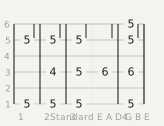
The low part in this exercise is a single repeated note on string 5 fret 5 — the root, A — played with the pick on every beat. The melody sits on the second and third strings and is played with the middle finger, one note per beat, arriving between the bass notes.
The rhythm is the hard part: both parts move at the same rate but they are produced by different fingers, so a small timing error between the pick and the plucking finger is immediately audible. At 62 BPM, each of the four beats has a bass note and a melody note — play them as a pair, not as two separate streams.
Practice block · Bars 1–2 · 62 BPM
The staff scrolls sideways. Point at a bar, or tab to one and use the arrow keys, to cue it.
Bars 3 and 4 — adding a second melody note
Bar 3 adds a second note to the melody on the second string, giving two melody notes against the bass on that beat. Bar 4 finishes with the melody jumping to the first string. Play bar 3 first with the melody alone, then add the bass — trying to learn both simultaneously at 62 BPM is where most of the frustration in hybrid picking comes from.
Keep the bass volume constant while the melody moves. Beginners tend to accent the melody notes and drop the bass, which turns a two-part arrangement back into a single line with a few stray low notes.
- Play the melody line of bar 3 alone with the middle finger.
- Add the bass notes on beats 1 and 3 only.
- Fill in the remaining bass notes until all four beats have one.
- Record the bar and listen specifically to the bass — it should be steady and even.
Practice block · Bars 3–4 · 62 BPM
The staff scrolls sideways. Point at a bar, or tab to one and use the arrow keys, to cue it.
| Pattern | Left | Right | What to listen for |
|---|---|---|---|
| Two parts, one beat | 1 (bass), 2 (melody) | ↓ (pick) + m | The bass and the melody note are one event, not two. Play them together. |
| Melody alone | 1-2 | m | Learn the melody line with no bass at all before you combine them. |
| Bass steadiness test | 1 (held) | ↓ ↓ ↓ ↓ | Play only the four bass quarter notes and record them; they should be identical. |
Questions
Do I need long fingernails for hybrid picking?
No, though a little nail on the middle finger helps produce a brighter, louder tone. Flesh-only plucking works and sounds warmer but is quieter, which matters when the pick is also hitting the low strings — most hybrid players keep a short nail on the middle finger for that reason.
Is hybrid picking the same as fingerstyle?
No. Fingerstyle usually abandons the pick and uses the thumb for the bass; hybrid picking keeps the pick for the low strings and uses the fingers for the high ones. That gives hybrid picking a harder, more percussive bass attack, which is why it is common in country and in rock playing that needs a driving low end.
Terms used in this lesson
Hybrid picking混合拨弦(Hybrid)
Holding the pick between thumb and index finger while also using the middle and ring fingers to pluck strings directly. Hybrid picking lets a single hand play a bass line and a melody at once, because the pick can take the low strings while the free fingers take the high ones.
String skipping跳弦(String skipping)
Playing a line that leaps over one or more strings instead of moving to the neighbouring one. Skipping breaks the scale's visual box, forces the picking hand to control a wider arc, and is used to write melodies that would sound like plain scales if every note were on adjacent strings.
Alternate picking交替拨弦(上下交替)
Strictly alternating down and up strokes with the pick, one stroke per note. Alternate picking gives even rhythm and high attainable speed once the up stroke is as strong as the down, but it forces a change of stroke direction at every string crossing, which is where most players lose time.
Open string空弦(不按品)
A string played without pressing any fret, written as 0 in tab. Open strings ring longer and sound brighter than fretted notes because the whole string length vibrates, and they cannot be bent by the left hand — which is why phrases that need expression avoid landing on them.
Plate files (SVG)
Fretboard matrix plate · Tab staff plate
/img/fret-hybrid-picking-bass-line-under-a-melody.svg · /img/tab-hybrid-picking-bass-line-under-a-melody.svg