D Dorian across frets 4–6: the mode with a natural sixth
Fretquest · Scale map · Band II · advanced
D 多利亚在 4–6 品:带自然六度的调式
- Tuning
- Standard E A D G B E
- Fret window
- Frets 4–6
- Scale
- D Dorian
- Root
- D
- Tempo
- 66 BPM
- Difficulty
- 4 / 5 · advanced
One note away from D minor
D natural minor is D E F G A B flat C. D Dorian is D E F G A B C. The two scales share six notes and differ in exactly one: the sixth degree, which is B flat in minor and B natural in Dorian. Everything else — the flat third, the perfect fifth, the minor seventh — is identical, which is why Dorian sounds minor but noticeably brighter.
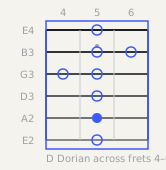
On the guitar, that difference is almost always a one-fret move. In the window below, string 2 fret 6 is F natural and string 2 fret 7 would be F sharp, but the note that matters is string 2 fret 5, which is E, and string 3 fret 4, which is B — the natural sixth that makes the mode Dorian rather than minor.
- String 6: fret 5 = A (degree 5)
- String 5: fret 4 = G sharp, out of the mode; fret 5 = D (root)
- String 4: fret 4 = F sharp, out of the mode; fret 5 = G (degree 4)
- String 3: fret 4 = B (degree 6, the note that makes it Dorian); fret 5 = C (degree 7)
- String 2: fret 5 = E (degree 2); fret 6 = F (degree 3)
- String 1: fret 5 = A (degree 5)
Why the window is not fully chromatic-ish
Unlike a pentatonic shape, a mode fills every degree, so the window contains notes on almost every string and fret combination that belongs to the mode. That makes the position harder to read at a glance than a five-note box, and it is the reason modal playing usually starts with the player naming the root and the sixth degree first.
Practise the window by degree rather than by fret: play 1, then 2, then 3, and stop. Then play 1, 2, 3, 4, and stop. Building the scale in degree order from the root makes the one-note difference from D minor audible rather than theoretical.
- Play string 5 fret 5 — the root D — and hold it for two beats.
- Play degree 2 on string 2 fret 5, degree 3 on string 2 fret 6.
- Play degree 6 on string 3 fret 4 and listen to how bright it is against the root.
- Repeat the whole run one fret lower to hear the same mode in D flat.
Four bars, ending on the sixth
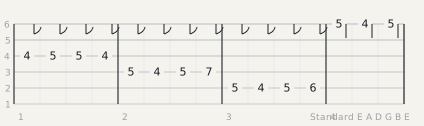
The tab starts on the third string with a two-note rock between frets 4 and 5, moves to the fourth string and reaches up to fret 7, then takes the second string up through frets 5 and 6 before closing on the second string with a three-note descent. The figure deliberately ends on B natural — the Dorian sixth — which is the note that defines the mode.
Play it at 66 BPM. When it is even, try replacing the closing note with B flat (string 3 fret 3): the phrase will suddenly sound like natural minor. That comparison is worth doing once, properly, because it fixes the sound of the sixth degree in your ear for good.
Practice block · Bars 1–4 · 66 BPM
The staff scrolls sideways. Point at a bar, or tab to one and use the arrow keys, to cue it.
| Pattern | Left | Right | What to listen for |
|---|---|---|---|
| Two-note rock | 1-2 | i m | Frets 4 and 5 on string 3, back and forth. Keep the index down between attacks. |
| Reach on string 4 | 1 → 4 | m i | Fret 5 to fret 7 is the widest move in the window; keep the thumb behind the neck. |
| Sixth-degree ending | 1 | p | Land on B natural (string 3 fret 4) and hold it. Then repeat with B flat on fret 3 to hear the difference. |
Questions
Is Dorian just a major scale played from the second note?
Physically yes — D Dorian contains the same seven notes as C major. Musically no: the scale is defined by which note is the home note, and D Dorian resolves to D while C major resolves to C. The same seven notes produce a different sound because the listener hears a different root.
What is the sixth degree used for in practice?
It is the characteristic note of the mode, so it is usually placed on strong beats or used as the note a phrase lands on. In D Dorian that means treating B natural as a destination rather than a passing note — which is exactly what the four-bar phrase at the end of this lesson does.
Terms used in this lesson
Scale degree音阶级数(Scale degree)
The number a scale note occupies when the scale is counted from its root upward: 1 for the root, 2 for the next note, and so on. A prefix of b lowers the degree by a semitone and # raises it, so b3 means the third degree flattened — the note that makes a minor pentatonic sound minor.
Root note根音(第一级音)
The note a scale or chord is named after and the note the music resolves to. In a scale diagram the root is marked differently from every other degree because it is the pitch the ear hears as home, and phrases that end on it sound finished while phrases that end elsewhere sound suspended.
Position playing把位演奏(Position)
Playing with the hand parked at one place on the neck, so that the index finger covers one fret and the other fingers cover the frets above it. Positions are numbered by the fret the index finger sits on: first position puts the index at fret 1, second position at fret 2, and so on.
Fret marker品位标记(点)
The inlay dots on the fretboard, placed at frets 3, 5, 7, 9, 12, 15 and above. Markers are landmarks for the left hand when shifting and for the eye when reading: the double dot at fret 12 marks the octave, and knowing where it is keeps the hand from drifting a fret sharp or flat.
Plate files (SVG)
Fretboard matrix plate · Tab staff plate
/img/fret-d-dorian-across-second-position.svg · /img/tab-d-dorian-across-second-position.svg