Economy picking: three notes per string and the sweep between them
Fretquest · Technique · Band II · intermediate
经济拨弦:每弦三音与跨弦的顺势扫过
- Tuning
- Standard E A D G B E
- Fret window
- Frets 4–6
- Scale
- A minor pentatonic
- Root
- A
- Tempo
- 70 BPM
- Difficulty
- 3 / 5 · intermediate
The rule, and how it differs from strict alternation
Inside a single string, economy picking alternates exactly like alternate picking. At the moment you move to an adjacent string in the direction of the sweep, the pick plays the same direction twice in a row — down-down when ascending, up-up when descending. That is the whole technique.
The saving is real but small: one pick stroke per string change. The cost is also real: the two consecutive same-direction strokes have to be a controlled sweep rather than a lunge, or the second note will be much louder than the first. Most of the practice time goes into evening out that pair.
- Ascending three-note figure: down-up-down, then sweep down into the next string
- Descending three-note figure: down-up-down reversed, sweeping up into the next string
- String change in the opposite direction: falls back into strict alternation naturally
- Volume target: the swept note within 2 dB of the note before it
Bars 1 and 2 — ascending on three strings
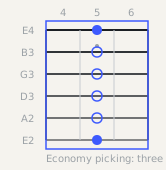
Bar 1 plays frets 4, 5 and 6 on the third string in sixteenth notes, then repeats the top two notes before moving. Bar 2 takes the same figure down to the second string and repeats it. Both bars are ascending patterns, so the economy stroke happens on every string change and there are eleven sweep moments in two bars.
Watch the pick height at the string change. A sweep that lifts away from the strings produces a gap; a sweep that presses in produces a scratch. The pick should travel in a shallow arc that just clears the string it has finished with.
- Play bar 1 at 60 BPM and name the pick direction of every note out loud.
- Mark the two notes that share a direction at the string change.
- Play the bar again, listening only to that pair — it must be even.
- Add bar 2 once three clean repetitions of bar 1 are done.
Practice block · Bars 1–2 · 70 BPM
The staff scrolls sideways. Point at a bar, or tab to one and use the arrow keys, to cue it.
Bars 3 and 4 — descending, then the check bar
Bar 3 reverses the figure and crosses between the first and second strings in eighths, which slows the note rate enough to hear each sweep clearly. Bar 4 is the control: three quarter notes on the fifth string with no string change at all, so any unevenness there is a left-hand problem rather than a picking one.
At 70 BPM these four bars take under seven seconds. Play them eight times in a row and stop at the first repetition where a swept note stands out.
Practice block · Bars 3–4 · 70 BPM
The staff scrolls sideways. Point at a bar, or tab to one and use the arrow keys, to cue it.
| Pattern | Left | Right | What to listen for |
|---|---|---|---|
| Ascending three-note cell | 1-2-3 | ↓ ↑ ↓ ↓ (sweep) | The last downstroke is the sweep into the next string. Keep the pair even. |
| Descending cell | 3-2-1 | ↓ ↑ ↑ (sweep) | Descending, the sweep is an upstroke. Same rule, mirrored. |
| No-string-change control | 1 (held) | ↓ ↑ ↓ | Bar 4 has no string changes at all — if it is uneven, the fault is in the left hand. |
Questions
Should I learn alternate picking or economy picking first?
Alternate picking first, without exception. Economy picking is a deliberate exception to a rule, and you cannot manage an exception cleanly until the rule is automatic. Six months of strict alternation is a common and reasonable prerequisite before adding sweeps.
Is economy picking only useful for three-note-per-string scales?
It helps most where consecutive notes fall on adjacent strings in the same direction, which is exactly what three-note-per-string patterns do. On two-note-per-string patterns the sweeps are rarer and the benefit is smaller, and on patterns with string skips it does not apply at all.
Terms used in this lesson
Economy picking经济拨弦(Economy)
Combining alternate picking with sweep strokes, so that when a phrase crosses to an adjacent string the pick continues in the direction it was already moving instead of reversing. Economy picking is smoother across string changes and harder to keep rhythmically even than strict alternate picking.
Alternate picking交替拨弦(上下交替)
Strictly alternating down and up strokes with the pick, one stroke per note. Alternate picking gives even rhythm and high attainable speed once the up stroke is as strong as the down, but it forces a change of stroke direction at every string crossing, which is where most players lose time.
String skipping跳弦(String skipping)
Playing a line that leaps over one or more strings instead of moving to the neighbouring one. Skipping breaks the scale's visual box, forces the picking hand to control a wider arc, and is used to write melodies that would sound like plain scales if every note were on adjacent strings.
Plectrum拨片(Pick)
The pick, held between thumb and index finger with only a small tip protruding. How much tip is exposed controls the tone as much as the pick's thickness: a small tip produce a tighter, more controlled attack and less pick noise against the strings, while a large tip produces a louder, sloppier one.
Plate files (SVG)
Fretboard matrix plate · Tab staff plate

/img/fret-economy-picking-three-notes-per-string.svg · /img/tab-economy-picking-three-notes-per-string.svg