A minor pentatonic in position I: the open-string shape
Fretquest · Scale map · Band I · first week
A 小调五声 · 第 I 把位(1–3 品)的空弦形状
- Tuning
- Standard E A D G B E
- Fret window
- Frets 1–3
- Scale
- A minor pentatonic
- Root
- A
- Tempo
- 68 BPM
- Difficulty
- 1 / 5 · first week
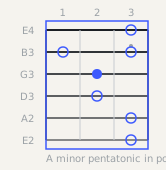
Where the seven fretted dots sit
Inside the 1–3 window the shape uses seven fretted notes: string 6 fret 3 (G), string 5 fret 3 (C), string 4 fret 2 (E), string 3 fret 2 (A), string 2 fret 1 (C) and fret 3 (D), string 1 fret 3 (G). The A itself arrives on an open 5th string, the D on an open 4th, the G on an open 3rd and the E on an open 1st, which is why this shape feels so much larger than three frets of neck.
Only two notes in the whole shape land on the root: the open 5th string and string 3 fret 2. Both are drawn as solid dots on the plate above. Everything else is a third, fourth, fifth or flat seventh of A, which is the entire vocabulary of the minor pentatonic.
- String 6, fret 3 — G, flat seventh
- String 5, open — A, root; string 5, fret 3 — C, flat third
- String 4, open — D, fourth; string 4, fret 2 — E, fifth
- String 3, open — G, flat seventh; string 3, fret 2 — A, root
- String 2, fret 1 — C, flat third; string 2, fret 3 — D, fourth
- String 1, open — E, fifth; string 1, fret 3 — G, flat seventh
Fretting-hand setup
Park the index finger on the 1st fret of the 2nd string and keep it there for the whole exercise; it is the only fret-1 note in the shape. The middle finger covers fret 2 and the ring finger covers fret 3. Resist the urge to barre anything — in this window each finger owns its own note and the hand stays square to the neck rather than rolled toward the floor.
- Set the thumb behind the neck roughly opposite the index and middle fingers, not hooked over the top.
- Press with the fingertip, not the flat of the finger, so the string rings without touching a neighbour.
- Play each note alone, once, and listen for buzz before you play any pattern at all.
Four-bar ascending cell at 68 BPM
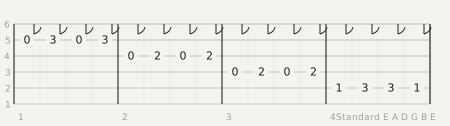
The tab below walks up one string per bar in even eighth notes, starting on the open 5th and finishing on the second string. Four bars, four different strings, one note per half beat — this is the first exercise most players use to memorise the position because it forces the picking hand to cross strings slowly and deliberately.
- Bar 1: A open, C fret 3, repeated on the 5th string
- Bar 2: D open, E fret 2, repeated on the 4th string
- Bar 3: G open, A fret 2, repeated on the 3rd string
- Bar 4: C fret 1, D fret 3 on the 2nd string
Practice block · Bars 1–4 · 68 BPM
The staff scrolls sideways. Point at a bar, or tab to one and use the arrow keys, to cue it.
Common mistakes in the first week
The two faults that show up over and over are a collapsed index finger — the first joint bending backwards so the string goes dead — and picking the open 5th string too hard because it is loud and easy. Both are audible in a recording. Play the four bars into a phone at 68 BPM and listen back; the open strings should be the same volume as the fretted ones, and every fretted note should sustain as long as an open string does.
- Index finger collapsing at the first joint — the string goes dead under it
- The open fifth string picked harder than the fretted notes around it
- A fretted note that dies sooner than an open string in the same bar
- Recording the four bars at 68 BPM is the fastest way to hear both
| Pattern | Left | Right | What to listen for |
|---|---|---|---|
| Open + fret 3 walk | 3 | i m i m | Ring finger only. Keep the index and middle fingers relaxed and clear of the neck. |
| String 2 crawl | 1-3-3-1 | i m m i | The index stays planted on fret 1 while the ring finger reaches fret 3 and returns. |
| Root check | 2 | m | Play string 3 fret 2, then string 5 open. Same note, different octave — they must match in pitch class. |
Questions
Why does my open 5th string sound so much louder than the fretted notes?
Open strings have no finger damping the vibration, so they project harder. Reduce the pick depth for open notes: let only about two millimetres of the tip cross the string, and keep the fretted notes at the same pick depth and volume rather than hitting the fretted notes harder to catch up.
Do I need to memorise the note names before I use the shape?
No, but you should know where the two roots are — the open 5th string and string 3 fret 2 — because those are the notes you will bend, hold and end phrases on. The other five notes can be learned over a week of slow practice rather than up front.
Terms used in this lesson
Box position方框把位(Box position)
A compact group of scale notes that sits under the hand in one place on the neck, playable without shifting. A box is defined by its lowest fret, not by its root, and the same box shape appears at several places on the neck because the guitar's tuning repeats the same intervals between string pairs.
Root note根音(第一级音)
The note a scale or chord is named after and the note the music resolves to. In a scale diagram the root is marked differently from every other degree because it is the pitch the ear hears as home, and phrases that end on it sound finished while phrases that end elsewhere sound suspended.
Scale degree音阶级数(Scale degree)
The number a scale note occupies when the scale is counted from its root upward: 1 for the root, 2 for the next note, and so on. A prefix of b lowers the degree by a semitone and # raises it, so b3 means the third degree flattened — the note that makes a minor pentatonic sound minor.
Open string空弦(不按品)
A string played without pressing any fret, written as 0 in tab. Open strings ring longer and sound brighter than fretted notes because the whole string length vibrates, and they cannot be bent by the left hand — which is why phrases that need expression avoid landing on them.
Plate files (SVG)
Fretboard matrix plate · Tab staff plate
/img/fret-a-minor-pentatonic-position-i.svg · /img/tab-a-minor-pentatonic-position-i.svg