Alternate picking: down-up on every eighth note
Fretquest · Technique · Band I · building
交替拨弦:每个八分音符都下上下上
- Tuning
- Standard E A D G B E
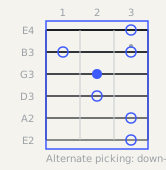
- Fret window
- Frets 1–3
- Scale
- A minor pentatonic
- Root
- A
- Tempo
- 76 BPM
- Difficulty
- 2 / 5 · building
The rule and why it is rigid
Say the pattern out loud before you play it: down-up-down-up. The pick angle stays constant and the motion comes from the wrist, not the elbow. The point of the rigidity is speed economy: an alternating pick travels the shortest possible distance between two notes, while a pick that always plays downstrokes has to return through the string before it can hit the next note.
The trade-off is that upstrokes sound different from downstrokes on most guitars — slightly quieter and with a different attack. Fix that with the pick angle rather than by hitting harder on the upstroke. Tilting the pick a few degrees toward the floor evens out the two directions.
- Pick depth: about 2 mm past the string, no more
- Motion: wrist rotation with a loose, closed fist — the elbow stays still
- Anchor: the heel of the picking hand rests lightly on the bridge or the strings behind the bridge
- Direction: strict alternation, even when you cross strings
Bars 1 and 2 — one string pair at a time
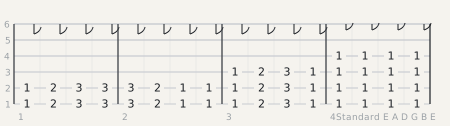
Bar 1 walks frets 1-2-3-3 on the second string, bar 2 walks back down. Both are pure down-up alternation, four notes per string per bar in eighth notes. Because the fretting hand is doing nothing unusual, this is the cleanest place to check that the upstroke is as loud as the downstroke.
Record one bar at 76 BPM and look at the waveform in any free audio editor: the peaks should be roughly equal. If every second peak is lower, the upstroke is being played with the arm rather than the wrist.
Practice block · Bars 1–2 · 76 BPM
The staff scrolls sideways. Point at a bar, or tab to one and use the arrow keys, to cue it.
Bar 3 — crossing three strings inside one bar
Bar 3 is the first place where alternation is tested properly, because the pick has to cross from the second string to the first and back while keeping the down-up sequence intact. The instinct is to reset the pattern at each string change so the new string starts on a downstroke; resist it. Three strings, four notes each, twelve eighth notes, alternating the whole way through.
- Play bar 3 at 60 BPM and count the pick directions out loud.
- Stop the moment the sequence breaks, restart the bar from the beginning.
- When three repetitions in a row are clean, move to the next bar.
- Add 4 BPM only after a clean run at the current tempo.
Practice block · Bars 3–3 · 76 BPM
The staff scrolls sideways. Point at a bar, or tab to one and use the arrow keys, to cue it.
Bar 4 — sixteenth notes on four strings
The last bar doubles the note density to sixteenths and spreads the pattern over four strings. At 76 BPM that is roughly five notes per second, which is slow enough to stay accurate and fast enough to expose any upstroke that is being faked with the elbow. If the bar collapses, halve the tempo rather than switching to all downstrokes — the whole value of the exercise is that the pick alternates when it is inconvenient.
Practice block · Bars 4–4 · 76 BPM
The staff scrolls sideways. Point at a bar, or tab to one and use the arrow keys, to cue it.
| Pattern | Left | Right | What to listen for |
|---|---|---|---|
| Single string down-up | 1-2-3-3 | ↓ ↑ ↓ ↑ | Pick angle constant. The wrist moves, the elbow does not. |
| Three-string crossing | 1-2-3-1 | ↓ ↑ ↓ ↑ ↓ ↑ | Do not restart the sequence on a new string; keep counting the direction. |
| Sixteenth-note burst | 1 (held) | ↓ ↑ ↓ ↑ (×4) | Four notes per beat for one bar. Accuracy first, tempo second. |
Questions
Do I have to alternate even when I change strings?
Yes — that is the entire discipline. The alternative, restarting on a downstroke after every string change, is called economy picking and it is a legitimate technique, but it is a different one. Learn strict alternation first; you cannot choose between the two until both are available to you.
Is a thin pick or a heavy pick better for this?
For learning alternation, a medium pick of about 0.73 mm to 0.88 mm is the easiest to control: thin picks flex too much on the upstroke and blur the attack, heavy picks of 1.14 mm and up demand more precision than a beginner's wrist can supply evenly in both directions.
Terms used in this lesson
Alternate picking交替拨弦(上下交替)
Strictly alternating down and up strokes with the pick, one stroke per note. Alternate picking gives even rhythm and high attainable speed once the up stroke is as strong as the down, but it forces a change of stroke direction at every string crossing, which is where most players lose time.
Plectrum拨片(Pick)
The pick, held between thumb and index finger with only a small tip protruding. How much tip is exposed controls the tone as much as the pick's thickness: a small tip produce a tighter, more controlled attack and less pick noise against the strings, while a large tip produces a louder, sloppier one.
Metronome节拍器(Metronome)
A steady click at a fixed tempo, measured in beats per minute. The metronome does not make playing faster; it reveals where the playing stops matching the beat, which is the information you need before speed can be added at all. Practising without one usually means practising the same errors.
Palm mute掌闷音(Palm mute)
Resting the edge of the picking hand lightly on the strings just in front of the bridge saddles to shorten the note and cut its high frequencies. Moving the hand toward the bridge makes the mute lighter and the note longer; moving it away from the bridge kills the note entirely.
Plate files (SVG)
Fretboard matrix plate · Tab staff plate
/img/fret-alternate-picking-eighth-note-study.svg · /img/tab-alternate-picking-eighth-note-study.svg