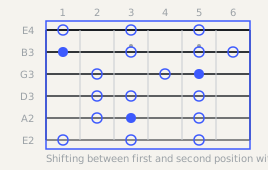
Shifting between first and second position without a gap
Fretquest · Position study · Band I · building
在第 I 与第 II 把位之间无痕换把
- Tuning
- Standard E A D G B E
- Fret window
- Frets 1–6
- Scale
- C major (Ionian)
- Root
- C
- Tempo
- 60 BPM
- Difficulty
- 2 / 5 · building
The guide finger is the whole technique
When you shift, one finger keeps light contact with the string and slides along it to the new fret. That finger is the guide. Without a guide the hand lifts, the string stops ringing, and the shift becomes audible as a gap rather than as a slide.
In the phrase below, the index finger is the guide both ways. Going up, it travels from fret 4 to fret 5 on the third string while the middle finger prepares the next note; coming down, the same finger releases pressure slightly and slides back to fret 4. The pressure release matters: a finger that stays fully pressed will squeak audibly on the wound strings.
- Shift on a finger that is already on the string — never shift on an open string or on a rest
- Release about half the pressure before sliding, then re-press at the destination
- Do not look at the neck; the guide finger finds the fret by feel
- Keep the thumb behind the neck and moving with the hand — no squeezing
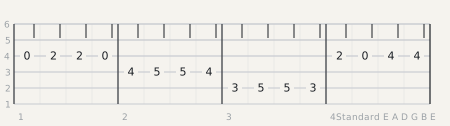
Bars 1 and 2 — shifting up on the third string
Bar 1 stays in the low window: open third string, then fret 2 with the middle finger, played as quarter notes. Bar 2 is the same shape one position higher — fret 4 with the index, fret 5 with the middle — so the shift happens on the third string between the two bars, and the interval pattern repeats exactly.
Because the two bars are the same figure at different frets, this is the easiest way to hear whether the shift is clean. Any gap or squeak stands out immediately against the repetition.
Practice block · Bars 1–2 · 60 BPM
The staff scrolls sideways. Point at a bar, or tab to one and use the arrow keys, to cue it.
Bars 3 and 4 — shifting back down on the fifth string
The downward shift is harder for most players because the hand has to relax its grip while staying in contact with the string. Bar 3 plays frets 5 and 3 on the fifth string, so the index finger slides from 5 to 3 in the middle of the bar. Bar 4 returns to the low window and finishes on fret 0, which lets the string ring open as the hand settles.
Practise the downward shift alone at first: play string 5 fret 5, slide to fret 3, and listen for a continuous tone with no bump at the fret wire. A bump means the finger is pressing too hard during the slide.
- Play bar 3 at 60 BPM and count the slide out loud as one continuous note.
- Repeat twenty times without stopping; stop only if a buzz appears.
- Add bar 4 and check that fret 0 rings as long as the fretted notes did.
- Raise the tempo 4 BPM, but only if the slide is inaudible at the current speed.
Practice block · Bars 3–4 · 60 BPM
The staff scrolls sideways. Point at a bar, or tab to one and use the arrow keys, to cue it.
| Pattern | Left | Right | What to listen for |
|---|---|---|---|
| Shift up | 1 (guide) → 2 | i m | Index slides 4 to 5 on string 3 while the middle finger prepares. |
| Shift down | 1 (guide) → 1 | m i | Same finger travels from fret 5 to fret 3 on string 5. Halve the pressure first. |
| Arrival check | 1 | p | Play the arrival note alone against the click; it must sit on the beat, not after it. |
Questions
Should I shift on the beat or between beats?
Shift just before the beat that needs the new note, so the destination note lands exactly on the click. Shifting early leaves a pause; shifting late makes the note late. Practise with a metronome at 60 BPM and listen for the arrival note to be coincident with the click rather than after it.
How do I stop the wound strings squeaking when I slide?
Reduce left-hand pressure during the slide to roughly half and increase speed slightly. Squeak comes from the winding dragging under a fully pressed fingertip; a lighter, faster slide produces almost none, and on the electric guitar it disappears entirely with moderate gain.
Terms used in this lesson
Shifting换把(Shift)
Moving the left hand from one position to another during a phrase. A shift can be audible, with the fingertip sliding along the string and connecting the two positions, or silent, with the hand arriving before the next note is played — but an unplanned gap between the two is audible as a mistake.
Position playing把位演奏(Position)
Playing with the hand parked at one place on the neck, so that the index finger covers one fret and the other fingers cover the frets above it. Positions are numbered by the fret the index finger sits on: first position puts the index at fret 1, second position at fret 2, and so on.
Anchor finger锚指(固定手指)
A finger that stays pressed on one note while the others move around it. Anchoring reduces the amount of movement the hand has to make, keeps the hand oriented when the shape is unfamiliar, and gives the ear a fixed pitch to measure every other note against.
Open string空弦(不按品)
A string played without pressing any fret, written as 0 in tab. Open strings ring longer and sound brighter than fretted notes because the whole string length vibrates, and they cannot be bent by the left hand — which is why phrases that need expression avoid landing on them.
Plate files (SVG)
Fretboard matrix plate · Tab staff plate
/img/fret-shifting-between-first-and-second-position.svg · /img/tab-shifting-between-first-and-second-position.svg