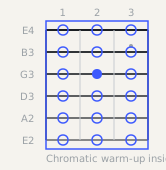
Chromatic warm-up inside frets 1–3
Fretquest · Position study · Band I · first week
1–3 品内的半音阶热身
- Tuning
- Standard E A D G B E
- Fret window
- Frets 1–3
- Scale
- A chromatic
- Root
- A
- Tempo
- 72 BPM
- Difficulty
- 1 / 5 · first week
Fingers 1-2-3-3, then back down
The pattern is simple by design: index, middle, ring on frets 1, 2, 3, then a repeat of fret 3 with the ring finger before you reverse. That repeated note is not decoration — it gives the ring finger a second attack in a row, which is where a collapsing first joint usually shows up first.
Work on the second string, whose frets 1, 2 and 3 are C, C sharp and D. Naming them as you play is optional, but it costs nothing and makes the drill double as note-finding practice. When the ascending half is clean, play bar two: the same three frets descending, 3-2-1, with the index finger arriving last and staying pressed.
- Bar 1: frets 1-2-3-3 with fingers 1-2-3-3, even eighth notes
- Bar 2: frets 3-2-1-1 with the same fingers in reverse
- Both bars use one string only — no string crossing, no right-hand complexity
Practice block · Bars 1–2 · 72 BPM
The staff scrolls sideways. Point at a bar, or tab to one and use the arrow keys, to cue it.
Keeping the fingers close to the strings
The most common fault in a chromatic warm-up is fingers flying away from the fretboard between notes. Lift a finger no more than a centimetre; anything more costs time on the way back and makes the drill sound uneven even at 72 BPM. A useful test is to place the palm of your picking hand flat against the strings, mute everything, and play the pattern silently — you should feel the fingers moving without the whole hand moving with them.
- Play bar 1 slowly with mutes on: no sound, only finger movement.
- Watch that the thumb stays behind the neck and does not travel.
- Release the mutes and play it for real at the same speed.
- Only then raise the metronome — 4 BPM at a time.
Bars 3 and 4: the doubled run
Once the basic cell is even, the second half doubles the note count per bar to eight eighth notes and adds a direction change in the middle of the bar rather than at the barline. That is the part that exposes an uneven ring finger: the pair 2-3-3 in bar 3, and the pair 3-3-2 in bar 4, must have the same spacing as the notes around them.
Keep the alternation strict while you do this — index finger on the first note, middle on the second, and so on regardless of which string you are on. If the picking hand stumbles, the tempo is too high; drop to 60 and rebuild.
Practice block · Bars 3–4 · 72 BPM
The staff scrolls sideways. Point at a bar, or tab to one and use the arrow keys, to cue it.
| Pattern | Left | Right | What to listen for |
|---|---|---|---|
| Ascending cell | 1-2-3-3 | i m i m | The ring finger plays twice; do not let the index drift off fret 1 in the meantime. |
| Descending cell | 3-2-1-1 | m i m i | Reverse the finger order but keep the alternation strict. |
| Silent check | 1-2-3-3 | muted | Palm muted, no sound. Watch the finger travel distance, not the notes. |
Questions
How long should a chromatic warm-up take?
Two to three minutes is plenty. It is a wake-up call for the hands, not a conditioning programme: four bars at 72 BPM, played twice on each of the six strings, covers every fret in the window and takes about ninety seconds once the movement is automatic.
Should I use this drill on all six strings at the same frets?
Yes, and that is exactly what makes it a position drill. Keep the hand in the same 1–3 window and move across strings rather than up the neck. Your thumb stays roughly opposite the index finger the whole time, and the wrist should not need to change angle between the low E and the high E.
Terms used in this lesson
Fret wire品丝(指板横条)
The metal strip set into the fretboard that the string contacts to produce a note. Pressing just behind a fret wire gives a clean note; pressing on top of the wire or halfway between two wires produces a buzz or a note that is out of tune, which is the usual cause of a chord that will not ring clearly.
Anchor finger锚指(固定手指)
A finger that stays pressed on one note while the others move around it. Anchoring reduces the amount of movement the hand has to make, keeps the hand oriented when the shape is unfamiliar, and gives the ear a fixed pitch to measure every other note against.
Fingering指法(左右手安排)
The plan for which finger plays which note, in both hands. Fingering is not fixed by the notes: the same passage can be played several ways, and the choice depends on what comes before and after, on which strings the phrase lands, and on whether the player wants a legato or a picked sound.
Position playing把位演奏(Position)
Playing with the hand parked at one place on the neck, so that the index finger covers one fret and the other fingers cover the frets above it. Positions are numbered by the fret the index finger sits on: first position puts the index at fret 1, second position at fret 2, and so on.
Plate files (SVG)
Fretboard matrix plate · Tab staff plate

/img/fret-chromatic-warmup-first-position.svg · /img/tab-chromatic-warmup-first-position.svg