Palm muting: the eighth-note pulse that keeps a riff tight
Fretquest · Technique · Band I · first week
掌根闷音:让连复段保持紧凑的八分音符脉冲
- Tuning
- Standard E A D G B E
- Fret window
- Frets 1–3
- Scale
- A minor pentatonic
- Root
- A
- Tempo
- 88 BPM
- Difficulty
- 1 / 5 · first week
Finding the mute point
Rest the edge of your picking hand across the strings immediately in front of the bridge saddles, then move it forward toward the neck in small steps while playing a single repeated note. There is a narrow band, usually about a centimetre wide, where the note becomes short and percussive but keeps its pitch. Behind that band the note rings freely; in front of it the string stops vibrating altogether.
That band is your mute point for this exercise. It moves when you change strings — the sixth string needs the palm slightly further back than the first — so check it again whenever you change string, rather than assuming one position works for all six.
- Too far back: no effect, the note rings as if unmuted
- Correct band: short note with an audible pitch, roughly a third of the original length
- Too far forward: dead thump with no pitch
- Check by ear, not by looking — the hand position looks nearly identical across all three cases
Bars 1 and 2 — pulse, then movement
Bar 1 is eight identical eighth notes on one fret. Its purpose is to establish a perfectly even pulse with the mute engaged: every note should be the same length and the same volume, which is harder than it sounds because the natural tendency is to let some notes ring longer than others.
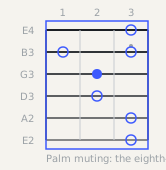
Bar 2 introduces movement with frets 1, 2 and 3 while keeping the mute in place. This is where most players lose the mute: as soon as the fretting hand starts moving, the picking hand lifts slightly and the last two notes of the bar ring out. Listen for that at 88 BPM and correct it before moving on.
Practice block · Bars 1–2 · 88 BPM
The staff scrolls sideways. Point at a bar, or tab to one and use the arrow keys, to cue it.
Bars 3 and 4 — muted against open
Bar 3 descends through the same three frets, and bar 4 finishes with four quarter notes where the mute is released on the last note so it rings. That contrast is the point of the exercise: a muted note and an unmuted note at the same pitch should sound like two different instruments, and controlling which one you get is the technique.
Practise the release deliberately. Play three muted quarters and one ringing quarter, over and over, until you can switch the mute off between one note and the next without any change in the picking hand's depth.
- Bar 4 with all four notes muted, even eighths feel maintained.
- Release the mute on the fourth note only; the pitch should bloom.
- Alternate muted and open notes on successive quarters without stopping.
- Return to the full four bars at 88 BPM and record it once to check consistency.
Practice block · Bars 3–4 · 88 BPM
The staff scrolls sideways. Point at a bar, or tab to one and use the arrow keys, to cue it.
| Pattern | Left | Right | What to listen for |
|---|---|---|---|
| Steady muted eighths | 1 (held) | ↓ ↑ ↓ ↑ | Bar 1: eight identical notes. All the same length, all the same volume. |
| Muted movement | 1-2-3 | ↓ ↑ ↓ ↑ | The picking hand must not lift when the fretting hand starts moving. |
| Mute release | 1 | ↓ | Bar 4 note 4: roll the palm back off the string and let the pitch bloom. |
Questions
Does palm muting work without distortion?
Yes, and it is easier to hear what you are doing on a clean sound because distortion compresses the difference in length between muted and open notes. Learn the technique clean, then add gain — the mute point does not change, but the acceptable width of the band becomes narrower.
Why do my muted notes lose their pitch completely?
The palm is too far forward, resting on the vibrating part of the string rather than just in front of the bridge saddles. Move the hand back in two-millimetre steps until the pitch returns; on most guitars the correct point is within a centimetre of the saddles.
Terms used in this lesson
Palm mute掌闷音(Palm mute)
Resting the edge of the picking hand lightly on the strings just in front of the bridge saddles to shorten the note and cut its high frequencies. Moving the hand toward the bridge makes the mute lighter and the note longer; moving it away from the bridge kills the note entirely.
Alternate picking交替拨弦(上下交替)
Strictly alternating down and up strokes with the pick, one stroke per note. Alternate picking gives even rhythm and high attainable speed once the up stroke is as strong as the down, but it forces a change of stroke direction at every string crossing, which is where most players lose time.
Metronome节拍器(Metronome)
A steady click at a fixed tempo, measured in beats per minute. The metronome does not make playing faster; it reveals where the playing stops matching the beat, which is the information you need before speed can be added at all. Practising without one usually means practising the same errors.
Fret wire品丝(指板横条)
The metal strip set into the fretboard that the string contacts to produce a note. Pressing just behind a fret wire gives a clean note; pressing on top of the wire or halfway between two wires produces a buzz or a note that is out of tune, which is the usual cause of a chord that will not ring clearly.
Plate files (SVG)
Fretboard matrix plate · Tab staff plate

/img/fret-palm-muting-eighth-note-pulse.svg · /img/tab-palm-muting-eighth-note-pulse.svg