Reading eighth and sixteenth note groups in tab
Fretquest · Technique · Band I · building
读懂六线谱里的八分与十六分音符组
- Tuning
- Standard E A D G B E
- Fret window
- Frets 1–3
- Scale
- A minor pentatonic
- Root
- A
- Tempo
- 64 BPM
- Difficulty
- 2 / 5 · building
Three stem shapes, three durations
Underneath every column in a tab staff there is a stem. A bare stem with no flag is a quarter note: one note per beat in 4/4. A stem with one flag is an eighth note: two per beat. A stem with two flags is a sixteenth note: four per beat. That is the entire system for the note values you will meet in practice material for the first year.
The flags are drawn at the foot of the stem, on the low-string side, and when several flagged notes belong to the same beat they are often joined by a single beam instead. Beamed groups read faster once you are used to them: count the beams, not the individual notes.
- No flag, bare stem: quarter note — one per beat
- One flag: eighth note — two per beat
- Two flags: sixteenth note — four per beat
- Beamed group: several flagged notes sharing one beam, played within the same beat
Bar 1 against bar 2: the same seven notes
Bar 1 of the tab plays eight eighth notes on a single string: frets 1-2-3-3-1-2-3-3. Bar 2 plays the same fourteen notes as sixteenths, which is the same melodic shape at double speed inside the bar. Both bars contain the same figures; the difference is entirely in the stems.
Set the metronome to 64 BPM and play bar 1, counting one-and-two-and-three-and-four-and. Then play bar 2, counting one-e-and-a-two-e-and-a and so on. The click should land on the same notes in both bars, but bar 2 fits twice as many notes between them.
Practice block · Bars 1–2 · 64 BPM
The staff scrolls sideways. Point at a bar, or tab to one and use the arrow keys, to cue it.
Bars 3 and 4: mixing values inside a phrase
Real music does not stay at one note value. Bar 3 mixes a descending figure in eighths with a repeated note, and bar 4 returns to quarter notes to close. Reading the change of value without stopping is the skill being built here: the hand should adjust speed on its own as soon as the stems change, without you having to count out loud.
A reliable way to check is to play bars 3 and 4 while tapping the beat with your foot. If your foot hesitates at the barline, you are reading ahead and losing the pulse — slow down to 56 BPM and rebuild.
- Play bar 3 and tap the beat with the foot at 64 BPM.
- Continue straight into bar 4 without pausing at the barline.
- Repeat the pair ten times; stop if the foot hesitates.
- Once ten clean repetitions are done, add 4 BPM and repeat.
Practice block · Bars 3–4 · 64 BPM
The staff scrolls sideways. Point at a bar, or tab to one and use the arrow keys, to cue it.
| Pattern | Left | Right | What to listen for |
|---|---|---|---|
| Eighth-note bar | 1-2-3-3 | i m i m | Two notes per click at 64 BPM. Count one-and-two-and out loud. |
| Sixteenth-note bar | 1-2-3-1 | i m i m (×4) | Four notes per click. The click lands on the first and third fingers of each group. |
| Value change at the barline | 3-2-1 | m i m | Do not slow the hand at the barline; the foot keeps the beat, the hand follows the stems. |
Questions
Do I need to count out loud, or can I count in my head?
At first, out loud. Counting in your head while also reading a new pattern fails for most beginners because the counting and the reading compete for the same attention. Say the subdivisions aloud until the ratio of notes to clicks is automatic, usually after two or three sessions on the same material.
What tempo should a written exercise be played at?
Start at whatever tempo lets you play the bar without a single mistake, even if that is 50 BPM, and only then add speed. A useful rule is to move up 4 BPM once you can play the passage five times in a row correctly; a tempo at which you make a mistake every second repetition is not building anything.
Terms used in this lesson
Tab stem谱音符干(时值)
The rhythm marking attached to a bar of tab: q for quarter notes, e for eighth notes, s for sixteenth notes. The fret numbers say which notes to play and the stem says how long each lasts, so the same fret numbers with a different stem are a different piece of music.
Tablature六线谱(TAB)
Notation that shows music as six lines, one per string, with numbers indicating which fret to press. Tab says nothing directly about pitch or duration — both have to be inferred from the tuning and the rhythm stems — but it removes the need to translate a written note into a fret before playing it.
Metronome节拍器(Metronome)
A steady click at a fixed tempo, measured in beats per minute. The metronome does not make playing faster; it reveals where the playing stops matching the beat, which is the information you need before speed can be added at all. Practising without one usually means practising the same errors.
Tempo ladder速度阶梯(Tempo ladder)
A practice method that raises the metronome in small steps — usually four BPM — and only after a fixed number of consecutive clean repetitions. The ladder makes the current ceiling explicit and turns speed into a measured result of accuracy rather than something attempted directly.
Plate files (SVG)
Fretboard matrix plate · Tab staff plate
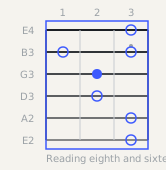

/img/fret-reading-eighth-and-sixteenth-note-groups.svg · /img/tab-reading-eighth-and-sixteenth-note-groups.svg