How to read tab: string order, fret numbers and stems
Fretquest · Technique · Band I · first week
怎么读六线谱:弦序、品数与符干
- Tuning
- Standard E A D G B E
- Fret window
- Frets 1–3
- Scale
- C major (Ionian)
- Root
- C
- Tempo
- 60 BPM
- Difficulty
- 1 / 5 · first week
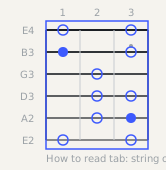
One line per string, high string on top
A six-line tab staff always shows string 1 (the thinnest, high E in standard tuning) on the top line and string 6 (the thickest, low E) on the bottom line. That is the opposite of how you look at the neck from above, which is where most of the confusion starts, so the first habit worth building is to say the string number out loud while you read a bar.
Every number you read is a fret, not a finger. A 3 on the third line means the third string, third fret — whichever finger you happen to use. Number 0 means the open string, played with no finger at all. Nothing in tab tells you which left-hand finger to use; that is exactly what the fingering table at the end of every Fretquest entry exists to supply.
- Top line = string 1 (high E), thinnest string
- Second line = string 2 (B)
- Third line = string 3 (G)
- Fourth line = string 4 (D)
- Fifth line = string 5 (A)
- Bottom line = string 6 (low E), thickest string
Numbers stacked vertically are played together
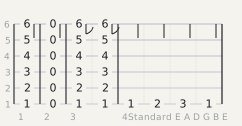
When two or more numbers appear in the same column, they are struck at the same time — that is the only way tab writes simultaneity. Reading order is always left to right, exactly like text. Bar two of the plate below is a single column of six zeros: every string open, all six struck together, which is a useful sanity check because the sound should be muddy and wide rather than six separate notes.
Practice block · Bars 2–2 · 60 BPM
The staff scrolls sideways. Point at a bar, or tab to one and use the arrow keys, to cue it.
Stems and flags under the staff
The small vertical line under each column is a stem, and the curl at its foot is a flag. One flag means eighth notes — two notes per beat in 4/4 — and a plain stem with no flag means quarter notes, one per beat. Your metronome clicks on the beat, so in an eighth-note bar there are two notes for every click.
Bars three and four of the tab show the difference directly: bar three is a column of eighth notes with flags, bar four is a run of quarter notes with bare stems. Play both against the same click and count out loud — one and two and three and four and — until the eighth-note bar lines up with the clicks the way the quarter-note bar does.
- Set the metronome to 60 BPM, one click per beat.
- Read bar three and play two notes per click, counting 1-and-2-and.
- Read bar four and play one note per click, counting 1-2-3-4.
- Alternate the two bars until the note-to-click ratio feels automatic.
Practice block · Bars 3–4 · 60 BPM
The staff scrolls sideways. Point at a bar, or tab to one and use the arrow keys, to cue it.
| Pattern | Left | Right | What to listen for |
|---|---|---|---|
| One string at a time | 1 | p | Read top line to bottom line while saying the string number out loud. Thumb only, rest stroke. |
| Six open strings | none | p i m a (thumb sweep) | Strike all six strings in one slow sweep so the column of zeros is heard as one event. |
| Eighth against quarter | 1-2-3 | ↓ ↑ ↓ ↑ | Bar 3 twice as fast as bar 4 against a fixed 60 BPM click. |
Questions
Is tab harder than standard notation for a beginner?
For the first month it is faster, because tab removes the note-reading step and leaves the physical mapping you actually need. Its blind spot is rhythm: tab shows you where to put your fingers but says much less about duration, so keep a metronome on and count out loud until the stems tell you the rhythm by themselves.
What does a number above the staff, outside the lines, mean?
Any number printed outside the six lines is not a fret. It is either a bar number, a position marker written above the staff, or a right-hand finger letter such as p, i, m or a. On Fretquest plates the fret numbers inside the staff always sit on a line; the numbers above the board are bar counts.
Terms used in this lesson
Tablature六线谱(TAB)
Notation that shows music as six lines, one per string, with numbers indicating which fret to press. Tab says nothing directly about pitch or duration — both have to be inferred from the tuning and the rhythm stems — but it removes the need to translate a written note into a fret before playing it.
Fret wire品丝(指板横条)
The metal strip set into the fretboard that the string contacts to produce a note. Pressing just behind a fret wire gives a clean note; pressing on top of the wire or halfway between two wires produces a buzz or a note that is out of tune, which is the usual cause of a chord that will not ring clearly.
String numbering琴弦编号(1–6 弦)
Guitar strings are numbered from the thinnest to the thickest: string 1 is the high E, string 6 the low E. Tab is written with string 1 on the top line, so the line order is the reverse of the physical order of the strings when the guitar is held in playing position.
Tab stem谱音符干(时值)
The rhythm marking attached to a bar of tab: q for quarter notes, e for eighth notes, s for sixteenth notes. The fret numbers say which notes to play and the stem says how long each lasts, so the same fret numbers with a different stem are a different piece of music.
Plate files (SVG)
Fretboard matrix plate · Tab staff plate
/img/fret-how-to-read-tab-string-order-and-fret-numbers.svg · /img/tab-how-to-read-tab-string-order-and-fret-numbers.svg