Hammer-ons and pull-offs: the legato drill that exposes both hands
Fretquest · Technique · Band I · intermediate
击弦与勾弦:同时暴露两只手的连奏练习
- Tuning
- Standard E A D G B E
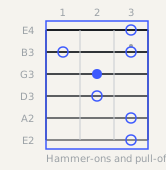
- Fret window
- Frets 1–3
- Scale
- A minor pentatonic
- Root
- A
- Tempo
- 60 BPM
- Difficulty
- 3 / 5 · intermediate
The mechanics of each half
For a hammer-on, the finger arrives from about two centimetres above the string and lands just behind the fret wire with enough speed to set the string vibrating. Dropping the finger from too high produces a slam and an inconsistent volume; pressing from too close produces a note that barely sounds. The correct height feels surprisingly low once it is working.
For a pull-off, the finger is not lifted — it is pulled sideways and downward off the string, so the tip plucks the string on its way past. A finger that lifts straight up produces silence or a faint click. This is the single most common fault in legato playing, and it is audible on every pull-off in a phrase.
- Hammer from about 2 cm, land just behind the wire, keep the finger pressed after landing.
- Pull off by dragging the fingertip sideways toward the palm, not by lifting it.
- Listen for the second note to be as loud as the first; if it is not, the pull-off is too weak.
- Keep the anchor finger on fret 1 pressed at all times, even when it is not sounding.
Bars 1 and 2 — hammer up, pull down
Bar 1 alternates fret 1 and fret 3 on the second string in eighth notes, hammering up each time: index holds fret 1, ring finger hammers fret 3, then releases back to fret 1. Bar 2 is the mirror image, pulling off from 3 to 1 every time, so the ring finger does all the work and the index finger only anchors.
At 60 BPM the note pair repeats twice per second. Play bar 1 ten times, then bar 2 ten times, and compare: the pull-off bar is normally noticeably quieter, which tells you the release is too vertical.
Practice block · Bars 1–2 · 60 BPM
The staff scrolls sideways. Point at a bar, or tab to one and use the arrow keys, to cue it.
Bar 3 — sixteenths, and where the drill bites
Bar 3 doubles everything to sixteenth notes for one bar, which is where the two halves are forced to match. Sixteen notes in one bar at 60 BPM means four notes per second produced entirely by the fretting hand, with the pick sounding only the first note of each pair. Any unevenness in the hammer or the pull becomes rhythmically obvious rather than just dynamic.
Do not raise the tempo for this bar until it is even at 60 BPM. Sixteenth-note legato at 60 BPM is the same note rate as eighth-note legato at 120, and it is far easier to fix finger problems at the slower tempo.
Practice block · Bars 3–3 · 60 BPM
The staff scrolls sideways. Point at a bar, or tab to one and use the arrow keys, to cue it.
Bar 4 and the volume test
Bar 4 returns to quarter notes and exists purely as a control: if the quarter-note version is uneven, the problem is not speed. Record bar 3 and bar 4 back to back on a phone and compare peak levels. Legato that is working has all four notes of a group within about two decibels of each other; legato that is not has a first note several decibels louder than the rest.
Practice block · Bars 4–4 · 60 BPM
The staff scrolls sideways. Point at a bar, or tab to one and use the arrow keys, to cue it.
| Pattern | Left | Right | What to listen for |
|---|---|---|---|
| Hammer up | 1 (held) → 3 | i | Only the first note is picked; the second comes from the fretting hand. |
| Pull down | 3 → 1 | m | Drag the ring finger sideways toward the palm; a vertical lift makes no sound. |
| Sixteenth legato | 1-3 (×8) | i m (on pairs) | Four notes per second, all even. Stop and slow down if the fourth note of a group is lighter. |
Questions
My hammer-ons are loud but my pull-offs are almost silent. What is wrong?
The finger is being lifted rather than dragged. A pull-off has to move sideways toward the palm so the fingertip catches the string and plucks it. Practise the motion in slow motion with the picking hand completely still: only the fretting hand should produce any sound at all.
Should the anchor finger stay pressed even between phrases?
It should stay in contact with the string, not necessarily pressed to the fretboard. Contact keeps the hand oriented and ready for the next hammer, while a fully relaxed and open hand has to find fret 1 again every time. Lifting a finger a few millimetres between phrases is enough to release tension without losing position.
Terms used in this lesson
Hammer-on击弦(Hammer-on)
Sounding a note by bringing a finger down hard onto a fret while the string is already vibrating, without picking it. The energy comes entirely from the finger's arrival, so a hammer-on played with a soft landing is quiet or silent — which is why hammer-ons above the twelfth fret need a firmer attack.
Pull-off勾弦(Pull-off)
Sounding a note by pulling a finger off a fret with a sideways drag, so that the fingertip plucks the string as it leaves. A pull-off that only lifts the finger makes no sound at all; the movement has to be a small, decisive pull toward the palm, not a lift away from the fretboard.
Legato连奏(Legato)
Playing with hammer-ons, pull-offs and slides instead of separate pick strokes, so that notes are joined rather than articulated individually. Legato produces a smooth, singing line and demands more of the left hand, because every note's volume and clarity now depends on finger pressure rather than the pick.
Anchor finger锚指(固定手指)
A finger that stays pressed on one note while the others move around it. Anchoring reduces the amount of movement the hand has to make, keeps the hand oriented when the shape is unfamiliar, and gives the ear a fixed pitch to measure every other note against.
Plate files (SVG)
Fretboard matrix plate · Tab staff plate

/img/fret-hammer-on-and-pull-off-legato-drill.svg · /img/tab-hammer-on-and-pull-off-legato-drill.svg