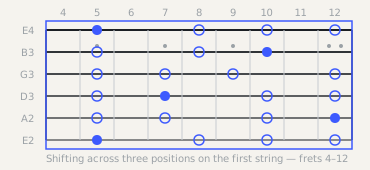
Shifting across three positions on the first string
Fretquest · Position study · Band II · advanced
在第 1 弦上跨越三个把位
- Tuning
- Standard E A D G B E
- Fret window
- Frets 4–12
- Scale
- A minor pentatonic
- Root
- A
- Tempo
- 58 BPM
- Difficulty
- 4 / 5 · advanced
What a shift actually costs
Moving the hand is not hard; moving it without a gap in the sound is. Every shift has three parts: the last note of the old position, the travel itself, and the first note of the new position. If the travel happens after the old note has been released, there is silence. If it happens while the old note is still ringing, the slide of the fingertip along the string becomes audible.
The second is usually the better choice: a short audible slide sounds intentional and keeps the line connected. What never works is releasing the string, moving, and then pressing again with nothing connecting the two notes — that is the gap beginners produce, and it is the specific fault this study targets.
- Play the last note of the position firmly, with weight
- Slide along the string to the new position without lifting the fingertip fully
- Land on the destination fret and press — the pressure arrives before the pick stroke, not with it
- Keep the thumb moving first; the fingers follow it
Bars 1 and 2 — climbing the first string
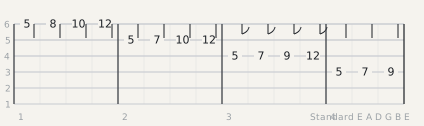
Bar 1 is a slow walk up the first string: fret 5 (A, the root), fret 8 (C), fret 10 (D), fret 12 (E). That is one note per beat on a single string, and it covers three positions in four beats — the hand has to move twice inside one bar.
Bar 2 does the same walk on the second string, where the same four pitches sit at frets 5, 8, 10 and 12 but resolve differently against the tuning. Playing the two bars back to back makes the point that the shape of a line on the fretboard is not the same as its shape in pitch: identical fret numbers on adjacent strings produce different intervals.
- Play bar 1 at 58 BPM with the metronome, listening for gaps at the shifts.
- If you hear a gap, keep the fingertip on the string during the travel and slide.
- Play bar 2 the same way and compare the intervals by ear.
- Join bars 1 and 2 without stopping between them.
Practice block · Bars 1–2 · 58 BPM
The staff scrolls sideways. Point at a bar, or tab to one and use the arrow keys, to cue it.
Bars 3 and 4 — the descent and the resolution
Bar 3 descends the fourth string from fret 12 to fret 5 in eighth notes, which is the same journey in half the time and with twice as many notes. Shifting at this speed requires the shift to happen on a beat boundary, so the metronome click covers the moment of movement.
Bar 4 finishes on the third string with a three-note figure at frets 5, 7 and 9, ending on E — the fifth degree of A minor pentatonic, which sounds unresolved on purpose. Hold it and listen for it wanting to continue to fret 12. That sense of wanting is the position's gravity, and knowing where it pulls is the real content of this lesson.
Practice block · Bars 3–4 · 58 BPM
The staff scrolls sideways. Point at a bar, or tab to one and use the arrow keys, to cue it.
| Pattern | Left | Right | What to listen for |
|---|---|---|---|
| Climb on string 1 | 1-1-2-4 | i m i m | Frets 5, 8, 10, 12. Two shifts inside one bar — keep the fingertip touching the string. |
| Silent shift | thumb leads | — | Move while the previous note rings; if you hear a gap, the release came too early. |
| Resolution | 1-2-4 on string 3 | i m i | Ends on E, the fifth — deliberately unresolved. Hold it and wait. |
Questions
Should a shift be audible or silent?
Both exist and you should own each deliberately. An audible slide connects the line and is standard in blues and rock playing; a silent shift keeps the notes separate and is standard in classical playing. What you want to avoid is an accidental gap, where the shift is neither quiet enough to be silent nor connected enough to be a slide.
How do I stop the hand from overshooting the new fret?
Aim with the thumb, not the fingers. The thumb moves first and settles on the back of the neck at the new position; the fingers arrive already knowing where they are going. Players who aim with the fingertips tend to overshoot and then correct, which shows up as a sharp or flat first note after every shift.
Terms used in this lesson
Shifting换把(Shift)
Moving the left hand from one position to another during a phrase. A shift can be audible, with the fingertip sliding along the string and connecting the two positions, or silent, with the hand arriving before the next note is played — but an unplanned gap between the two is audible as a mistake.
Position playing把位演奏(Position)
Playing with the hand parked at one place on the neck, so that the index finger covers one fret and the other fingers cover the frets above it. Positions are numbered by the fret the index finger sits on: first position puts the index at fret 1, second position at fret 2, and so on.
Anchor finger锚指(固定手指)
A finger that stays pressed on one note while the others move around it. Anchoring reduces the amount of movement the hand has to make, keeps the hand oriented when the shape is unfamiliar, and gives the ear a fixed pitch to measure every other note against.
Fingering指法(左右手安排)
The plan for which finger plays which note, in both hands. Fingering is not fixed by the notes: the same passage can be played several ways, and the choice depends on what comes before and after, on which strings the phrase lands, and on whether the player wants a legato or a picked sound.
Plate files (SVG)
Fretboard matrix plate · Tab staff plate
/img/fret-shifting-across-three-positions.svg · /img/tab-shifting-across-three-positions.svg